Amazon.com Widgets

The circle.

The circle is fundamental.

This simple shape, along with the square and the triangle, introduces our early minds to geometry, to symmetry, to physical and social design.

This past weekend I felt ashamed at Pagan Pride on account of a circle.
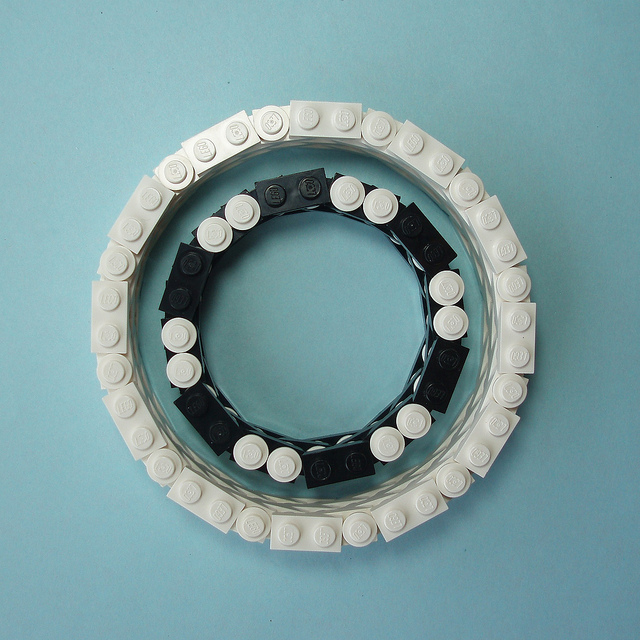
Photo by Katie Walker, Flickr

My body helped form the edge of a circle. My body stood next to other bodies — thirty perhaps — in the middle of one of the most public of spaces in all of Denver, Civic Center Park. This circle of bodies in the middle of my city, in the middle of a crowd of onlookers, did something I did not expect this circle to do.

It created an us and a them.

Casting circle before a crowd of people, some of whom were unsuspecting passers-by, and others virtually residents of the park, established a kind of religious exclusivity. It was as though we said, by joining hands and turning our backs to the crowd:

This is our circle. You are on the outside of this circle. We are doing our religious work on the inside.

The circle seemed to other the onlookers.

None of this was done explicitly. The leaders of the ritual, all good-hearted Pagans, did not inform the crowd that they were to remain outside, or that they were unwelcome in the ritual. They didn’t need to.

They’d invited us to come down for ritual, but the non-Pagans were not addressed. There was no clear explanation of what the ritual would be like, what might be expected of the participants, or — for those who weren’t familiar with Pagan (or more specifically, Wiccan/New Age-ish) rituals — what it would all mean.

The insiders were told that the ritual was going to raise power to bring us protection. The irony would be that this circle inspired the same antagonism and meanness from outside the circle from which the ritual was seeking to protect us.

There was heckling. It sounded like drunk heckling. Drunk, Christian heckling. And there were disruptions from a few men who, while we stood there in our circle, paced slowly around the perimeter. One asked for a cigarette. One stood outside the circle by about 5 feet and folded his arms across his chest.

The ritual leaders did not acknowledge any of this.

In response to the jeers and taunts, one ritual leader stood in solidarity inside the circle and began to talk to us about how protection was so important because there were people out there who didn’t understand us or respect us. It was as close to a “preaching” moment as you might find inside this kind of circle.

I heard her reassure us, and I thought,

But we just created an out there by casting this circle. We closed them off from us, shut them out, but only symbolically because they could see and hear all of what we were doing. Play it like we’re the victims, but we just created — through ritual — the same kind of alienation that we feel in relation to the greater society.

We just became The Church.
Photo by Mugley, Flickr

The rest of the ritual involved the distribution of smooth stones to each of us, stones which had been blessed and inscribed with a pentacle and the word, “protection.” These were our charms, we were told, to give us strength and to provide us protection as we leave the circle and go back into the world.

I found myself feeling so embarrassed. I kept looking down. I didn’t want protection from the people on the outside of the circle; I wanted to connect with them. To explain. To try to find some sort of understanding.

But it wasn’t my ritual.

To close, we imagined a ball of white light — the quintessential ball of white light — enveloping the circle, and then extending outward to include all of this place and all of the world. This imaginary light would attempt to do what we had not done with our physical bodies, which was to include all. In that moment our meditation, our magickal working, was an obvious self-deception; a willful ignorance of what was actually occurring in the space around us.

At least, that’s how it felt from where I was standing in the circle.

I don’t know about circles anymore. I don’t know if they’re appropriate to cast in these kinds of public settings. I doubt them in a way that I didn’t before Denver’s 2012 Pagan Pride.

I trust that many of you either cast circles, or have been in a ritual where one was cast. I wonder if you could shed some light on how you see them as useful, or how you find them to be problematic. Could you imagine other forms of ritual, ones that do not create a boundary between those on the outside and those within, that would feel appropriate at a Pagan gathering? Or, is this kind of “protective barrier” a necessity?

I felt ashamed at Pagan Pride because I was a part of something that felt, on account of the circle, incredibly exclusive. Could there be a more inclusive, perhaps even radically inclusive way of doing Pagan ritual in public?

Tagged with →  
Share →
  • http://www.facebook.com/profile.php?id=728865973 Crystal Groves

    That’s a toughie. I don’t particularly like circles either, though it is the easiest way to gather a group of people, religious or not. I like that ADF does not do the circle casting “barrier”, but we still worship in circles.

    I suppose an alternative method, or perhaps in addition to, is to be more inclusive before and during the ritual. Make it a horseshoe shape, perhaps, so that people could join in if they felt inclined to. Have people assigned to welcome others into the “grouping” that they might notice onlooking from outside. Perhaps line them up in rows like in a church, as awkward as that sounds it’s potentially doable, and more “familiar” to non-pagan onlookers.

    Just my thoughts. I’m sorry you felt ashamed, but I can certainly sympathize with why. Perhaps this is a lesson for other mass public gatherings in our future.

    • http://www.bishopinthegrove.com/ Teo Bishop

      Indeed. Thanks for the feedback, Crystal. A simple shift in shape — which my have required a shift in religious perspective — may have done the trick. For ADF’ers, this wouldn’t be much of a problem. But I imagine that some people might have difficulty abandoning the circle.

      In any case, thank you for the comment. I’m glad to see you a part of the dialogue here.

    • http://dashifen.com/ dashifen

      Horseshoes! I’ve never thought of that. Thanks!!

    • http://www.themonthebard.org/ Themon the Bard

      We used a horseshoe to great effect at Beltania this year. In our case, we had a stage with singers, so any attempt at a circle would have been just plain silly — we’d have been forced to surround the stage, putting half the people behind it, or we’d have shut out the singers entirely. The horseshoe worked really well: everyone could see everyone else, as in a circle, but the stage provided a focal point for the music and the ritual leader, who stood right in front of the stage. When we “cast the circle,” we went in front of the stage (trying to walk behind it would have been incredibly awkward), but simply raising the staff and pointing inclusively at the choir as we passed in front of the stage signaled the intent that the singers be part of the group.

      It worked.

  • http://www.groveofthelion.com/ Adrian Monogue

    Teo,

    One of the first things I always tell people is that if you don’t feel comfortable doing a ritual for any reason you can always ask to be let out.

    At rituals where I do a lot of crafting such as blacksmithing I do an “open” ritual. I, and others, can come and go from the space, but it is still a space set aside for magic.

  • Peter Dybing

    An important read. “We just became The Church.” That will hit you between the eyes!

  • http://www.facebook.com/fritterfae Eric Riley

    At almost every public Pagan event I attend there is a circle casting. And in some cases we have people who serve as guardians who help hold the integrity of that division, but who also serve as gatekeepers and informers to the onlookers. At every DC Pagan Pride the circle is held because we’re going to do some energy work and a ritual blessing of food in a reclaiming mode.

    So much of this revolves around the fact that we use Wicca as the lingua franca of the Pagan community. Wicca is most often the largest component of local Pagan groups, and it’s by default the first one we’re often exposed to through the predominance of Wicca in the Pagan publishing market. I feel it has become a shorthand to keep things comfortable and familiar with people, even if many of us have moved into different traditions with different modus operandi.

    I think the best Pagan Pride I attended was probably about 8 years ago when we had something along the lines of 5 different public rituals led by different trads. People really got to experience the difference between Reclaiming, ADF, OTO, and others. Each ritual had a different intent, and a different body of liturgy. It was revealing and I have to believe that it played a huge part in the success of those groups. Everyone had a table with literature explaining their beliefs. It was informative and fun and holy.

    But we’ve gone through major amounts of attrition in the DC Pagan community. Groups that have been around for a decade or so are dissolving. Circles led by a fiery high priestess have disbanded upon her death. People have moved away and moved on. I see more solitaries than ever, and their language is the language of Wicca.

    • http://www.facebook.com/profile.php?id=1535916213 Benjamin Hoshour

      There are so many areas on which to comment, but I will limit my response to one or two.
      Inclusivity is one of the reasons that ADF never casts a circle. Ritual “perimiters” are established after a fashion, but people are always free to come and go as they please and the lack of a closed circle certainly seems more inviting, especially insofar as public ritual goes. I use this example to illustatrate that powerful and effective ritual does NOT depend on a circle and can be done without one, which seems to be prefferable for public ritual for the resons you’ve discovered.
      The second point is that this whole “casting a cicle” business was adopted wholesale from ceremonial magick, which sought to control supernatural forces from which the magician needed protection. Casting a circle has never made sense to me on any level. For a tradition that espouses thd divine sacredness of the earth, it would be logical that everything is holy and sacred. This idea of protecting ourselves from malevolent forces or unwanted influence is another carry-over from ceremonial magick and doesn’t mesh at all with the pagan world-views of pantheism, monism, or panentheism. The idea that raised energy is “contained” within an imaginary circle drawn with a finger or a knife is wholle a mental construct and could be achieved, if one believed it needed to be, simply by focusing the mind.
      All in all, casting a circle seem to be totally unnecessary. I think the thing that bothers me most is that people adopt ritual behavior, such as the circle, without a careful analysis of WHy they are using it and whether it makes sense in the first place.

      • http://www.facebook.com/profile.php?id=1186404199 Crystal Hope Kendrick

        “if one believed it needed to be, simply by focusing the mind.” In small circles where more folks are likely to be “in the know” magically, this is often the case. In public rituals circles are usually cast in a visual and auditory ways for those who are not as familiar with the process. At least this has always been my experience when participating in or facilitating ritual. Visual and verbal cues are often needed so everyone is on the same page.

    • http://ofthespiae.hellenistai.com/ Ruadhán J McElroy

      So much of this revolves around the fact that we use Wicca as the lingua franca of the Pagan community. Wicca is most often the largest component of local Pagan groups, and it’s by default the first one we’re often exposed to through the predominance of Wicca in the Pagan publishing market. I feel it has become a shorthand to keep things comfortable and familiar with people, even if many of us have moved into different traditions with different modus operandi.

      And here, you may have likely described why I’m not really comfortable at most pagan events. I have never moved on from Wicca, cos I was never a part of it, in any form, to begin with. It’s unfamiliar in many ways, and just feels ill-fitting.

  • Rev. Michael J Dangler

    I’ve often thought that Druidic ritual has a boundary, but it’s not the hard boundary of a circle. It is, instead, the “place where the firelight no longer reaches.” In other words, if you can view the light of the fire, or be illuminated by it, then you are part of the rite.

    It’s a permeable boundary, where those who have an interest can enter in.

    That said, there are likely to be people who don’t want a connection: there are drunk hecklers, folks who are curious but disengaged, and silent protesters. We can’t force a connection onto them, but we *can* give them the option to engage with us.

    Public ritual must always be open and public, and that often means inviting the good and the bad. We have to make the choice about how to deal with the “bad” part as much as we do with the “good” part.

    Rites that are meant to be public need to have one (or a couple) assigned “ambassadors” who can answer questions, engage the public, and quiet hecklers if necessary during the rite. The best way to deal with people who are interested in interrupting tends to be to give them an ear that’s willing to engage them. . . outside the rite.

    And who knows: maybe they’ll come in one day.

    • Haeleron

      Without knowing much about Druidry, would a circle of stones be considered the “circle?”

      • Jason Dancingcrow

        It could well be.

      • http://www.facebook.com/patchshorts Chris Godwin

        Ancient Druids typically worshiped in groves of trees or where a branch of oak was present. We have no evidence that Stone circles were used by druids.

        In our contemporary era stone circles are often used.

  • http://dashifen.com/ dashifen

    Dude. Nail and head. I know the history behind casing circles and its connection to various forms of ceremonial magic. But I’ve always felt a certain disconnect between the idea of creating a separate, sacred space and the theology of most Paganisms indicates that the Earth itself is a sacred space.

    I can see the circle as a facility specifically for the raising of power and the containment of it until it is released for a specific purpose as a magical practice. I can see the circle as a tool for protection from things that are out-there that you don’t want in-here. And, I can even see the circle as a way of working within your own group in private as a way of spiritually indicating your own tribe by their physical presence within the circle. In short, I get the separation between mundane and magical and the symbolic power of that, but it’s not as relevant for me personally. And, I think it presents a negative picture of exclusivity to the public when we use them at events like PPD.

    Enough of that, though; I’ll offer some suggestions. I think we can alter the practice while keeping the intention the same. Instead of standing in the circle and holding hands as is (in my experience) the usual way of doing circles in public, why not just have someone move about the space to sacralize it as necessary. Then, leave it alone. We’ll know it’s there.

    If we need a physical representation, I’ve had better luck with squares rather than circles anyway. We can visualize a line between two points fairly easily but curves sort of throw me (us?) for a loop (ha!). Especially if you’re working with elemental quarters and the directions, we have a built in square about the space. Then, make your gathering within that square as is comfortable.

    The easiest way to alter the crowd dynamics in a ritual, I’ve found, is simply to move the altar. If it’s in the center of the crowd, we group around it. But, if you put it on the edge of the space (as defined either by your geography or by the quarters or by whatever you use) then all of a sudden we gather in front of it as a mob. Mobs are familiar to people and, in some ways, mobs are inviting. The curious will stop to see what’s going on and the even more curious may ask for more information. But, since there’s no boundaries to a mob, people can join and leave as they see fit.

    More practically, it also gets everyone facing the same direction which makes projecting the ritualists’ voices much easier and avoids the problem of having a speaker’s back to a certain portion of their audience.

    If you are sacralizing a space and you believe that this boundary should not be crossed, you may want to create some more obvious entry point for people to use. But, don’t put a physical door in it. Just make it an arch (e.g. one of those balloon arches so common at receptions would work) and then put it opposite your altar (after all, it’s not in the center anymore, is it?). People will tend to move through that arch to join your mob and you can then use that as the entry point not only to the physical space but also the sacred one as well.

    If you’re concerned about people ignoring the entry point and moving in from the sides, choose your geography to put trees, buildings, benches, etc. in the way to make the arch more inviting. Even put up signs along the sides asking people to enter from via the arch and many probably will follow that direction. The key is this: just don’t make it a human wall of linked hands with backs to the world as if we’re there to go-it-alone.

    If you want radically inclusive, then just don’t put up walls, entries, barriers, etc. Instead, have someone assigned to invite people to join the group if they’re standing to watch or just to answer questions outside of the ritual space during the practice. Most of the curious on-lookers are probably will have questions and they might not want to ask them at the end when they’re out-on-a-limb and/or confronted by a larger group of people. A one-on-one brief conversation, though, that’s easy.

    (whoa – can you tell I’m a ritual/ceremony design wonk)

  • Rebekah

    Very insightful. Even within Pagan gatherings we need to be aware of this. I went to a large ritual at a festival where the group leading, stood in a circle, in the middle of our larger one, and faced each other. We couldn’t hear them or see their faces and that created a similar dynamic to what you describe here. Thank you.

  • Nancy

    I don’t work a lot with circles for exactly the reasons you state – not all boundaries are necessary or good. I like spirals. Stuff can move in and out of a spiral. Lots of spirals are found in nature, but a perfect circle is hard to come by. There must be a reason for that.
    In my observation of the pagan community, many of us have an almost fond investment in the sense of ourselves as persecuted and in danger, both by people who don’t understand us and by “negative energy.”

    • http://dashifen.com/ dashifen

      There’s also a strong sense of subculture and counter culture to Paganism. I won’t deny that I revel in the otherness of being a magic worker and a Pagan from time to time, but I think we need to identify when it’s appropriate to do so.

  • Robin

    The choice of using civic center park for the festival was a challenging one, the space is often filled with people of varying life styles and drugs and alcohol are prevalent. Lots of homelessness. and poverty are seen readily. During the large events that happen there, there is a police presence that pushes this to the side..I don’t have problems dealing with people from this background, as I too, have been there. I think if we had formed a group to circle the park..and cleanse it and offer love a protection to all that inhabit and all that enter during this event it would have been powerful and inclusive. We learn by doing and this was something new for people and it was a risky event that turned out fine..I congratulate the organizers and hope in the future we learn and make adjustments.. I sorry you felt embarrassed and understand..I love the four agreements for this reason..and the one that stands out at the moment is “don’t take it personally” everyone did the best they knew how under the circumstances and hopefully this dialogue will bring about even more profound changes..thanks for seeing this and posting

  • http://www.xkcd.com/285 Eran Rathan

    I tend to see circles as having specific magical functions, but I don’t personally use them in my own rituals – I don’t incorporate magic into my rituals generally, so its kinda a non-starter for me. I can see where the disconnect comes from though, and I wonder if the leaders of the ritual had thought it through (it seems from your post that they weren’t exactly well organized – hardly an uncommon trait among pagans). It also seems that they were lacking a bit in communication (again, not an uncommon trait).

    Having an ‘open circle’, or even a pairing off (make a lot of little circles, but have them spread randomly around – like an English country dance) might take care of some of the issues you bring up.

  • http://www.facebook.com/profile.php?id=100000892067766 Anne Hatzakis

    It’s too bad you didn’t join in the Hellenic ritual. You would have been welcomed…. (I know, I led it)

  • http://johnfranc.blogspot.com/ John Beckett

    This is what happens when you follow a “standard” liturgy without mindfully considering what you’re doing, where you’re doing it, and why. What works well in a private gathering of 13 does not work well in a public gathering of 100, and vice versa.

    I highly recommend Isaac Bonewits’ “Neopagan Rites: A Guide to Creating Public Rituals that Work”.

  • Kieran Nightstar

    Thank you for the insight, and thought provoking reality check.

  • Hyperion

    Excellently written. This is precisely the reason we do not use a magical circle in the Unnamed Path. Why disconnect yourself from nature? Why disconnect yourself from those in the community? Usually the reasons given are protection, or to contain magical energy so that it can be sent out in one great burst. These are the trappings of the ceremonial magicians who founded early Wicca. We are not at threat from our environment. Our magic should not be weakened by being outdoors or in the public. Far from it. If we are part of nature, workers of spirit and worshippers of earth, sea and sky then why would we ever want to divorce ourselves energetically from all of that, or worse, think that we can command the elements to do our bidding. It is the greatest arrogance of any pagan to think they can command the elements of nature. No, we shouldn’t lord over nature for we are subject to it. We shouldn’t separate ourselves from our environment for we are subject to it. I encourage everyone to do away with the antiquated notion of the magical circle whose purpose is rooted in the summoning practices of the ceremonialists and instead find ways to connect with nature, connect with the earth and connect with everyone including those not participating in the ritual! Be a real shaman of the earth… not a living-room spell caster.

    • Ian Phanes

      What I get when I read this:
      “I encourage everyone to… find ways connect with everyone including those not participating in the ritual”…except those “antiquated” “living-room spell casters”.

      As someone who practices in multiple styles–including some with circles and some without–I wouldn’t feel welcome at an event described in the language you used. Is that your intention?

  • Eridanus

    I know what you mean. In DC, I am the co-Convener of Connect DC, a group which provides accessible and public ritual on the holidays. Our goal is to give everyone that bit of magic.

    We use Wiccan ritual and use the circle. However, our circle is permeable. We allow people to join us whenever they arrive and participate in what we are doing. If necessary, we reiterate our intention for newcomers as we continue our ritual.

    Yes, we have people watching from inside the circle to greet/meet people approaching us (if we don’t know them) to discover their intentions. Washington is a walking city with many small green spaces where people congregate, and we do ritual. As do many other groups: Christian, Pagan, Yoga, etc.

    We are doing public ritual, which means doing ritual in/for/introducing to the public. Defeats our purpose to exclude. Of course sometimes we other, but by what we are doing- people steer clear of chanting or dancing or praying or meditating groups. In addition, DC has many overlapping police jurisdictions and our greeters interact with them to explain what is happening.

    And I have experienced what Eric Riley said. Due to many factors, our Pagan Pride Day has become just the one ritual. You come for it, participate, visit a little, and leave. I remember the bigger ones and the ones which included our late High Priestess and the 10 year old group which has disbanded.

    Which means those of us of a ‘certain age’, need to start coming forward to mentor, aid, advise, and show the upcoming leaders/activists what we have learned, not only from our elders, teachers, and books but, from our experience. Knowledge is inert. It only becomes wisdom when we use it. As we were upcoming leaders/activists, we experienced much including upset (witch wars and the Pagan Leadership Skills Conference), catastrophe (I remember one Pagan Pride Day which crammed into a Lutheran church’s two large hallways and conference room because of a hurricane. We were welcomed and allowed to place our Pagan Pride Day banner on the outside of the church), and failure (a rummage sale which cost more to have than we sold). Today’s leaders seem to think only in the binary: win/lose, right/wrong, us/them.

    I remember, oh so long ago (more than 30 years) starting out on this path, all of the teachings, the books, and the people said to honor the elders, listen to their advice, and use the advice as you chose. There is no binary. It is an amazing variegated Universe. And our elders have glimpsed it. Our new leadership is based on social norms: what is not us is other. And the books no longer tell people to honor and listen to the elders. Perhaps, it would change what we are experiencing now.

    • http://heartacheintobeauty.blogspot.com/ Heartache Into Beauty

      I was also going to comment about the permeable circle at DC PPD, which I experienced for the first time this year. The circle felt welcoming and inclusive. It actually felt to me much like a cell’s semi-permeable membrane – allowing the good energy/people to flow freely, and keeping out the bad stuff.

  • Princess of Dork

    If the point of a public ritual is to invite the public to express interest and perhaps join in, I like the notion of having sacred space, without the hard boundaries of a closed circle, and the altar on the edge of it, rather than in the middle. I’ve been to such events where certain members of the organizing group remained outside of the designated space with flyers explaining what was going on and ways in which they could participate. It was welcoming and inclusive, without being disruptive to the ritual itself.

    However, being the somewhat cynical person that I am, I often question if the point of a public circle is to actually invite passers-by to become involved and perhaps find a new way in which to meet their spiritual needs or just to put on a public show.

  • Emily

    I really, seriously understand and appreciate your point. But it seems like, rather than the shape itself being responsible for the attitude that was created, it seems the fault of the individuals involved. Personally, I love circles. I love them because everyone in them is equal, able to see and participate in everything. I also love them because they can get bigger. New people can join and everyone else can just take a step back to adjust and grow the circle, and the new people are just as included as everyone else–as opposed to going into a building and sitting at the far back. In public spheres, it seems that the thing to do is make sure that everyone present, Pagan or otherwise, understands that they are welcome in circle, because circles are MEANT to make everyone feel included. Perhaps another thing to do would be to NOT focus the ritual around protection from the outside world at an event that is meant to educate and include the outside world.

  • Wes Isley

    I’ve always felt odd about casting circles since, like others have said, I consider everything sacred and don’t adhere to the opinion that there are forces out there just waiting to harm me. But to your point, yes, we all need to be more aware of what’s going on around us when holding ritual of any kind. It’s easy to get lost in what we doing, the mechanics and so on, but it would’ve been great if the leader or someone could’ve stopped just a sec and made a space to welcome others.

  • PhaedraHPS

    The downside of a circle is that if the geometry has been selected as exclusionary, it’s very successful. If you’re on the outside, you’re looking at a ring of backs. The upside of a circle is that everyone is looking at everyone else.

    I’ve both led and participated in lots of public rituals in public spaces that involved circles, either formally restrictive or ADF come and go as you please loose. Once, back in the ’80s in Chicago in Lincoln Park, my old friend Christa Landon and I were literally stoned–hit by thrown rocks–while leading a ritual. We chose not to acknowledge it, and most participants had no idea anything had happened. When Isaac lead the Blessed Be and Meet Me in DC (BBMMDC) rite back in 2000, with a hundred or more participants in a circle outside the FDR memorial, someone broke through and threatened the facilitators. After that person was removed, the Park Service rangers patrolled our perimeter.

    So much depends on context and intent. If it is essentially a private rite in a public place (the example I gave from the ’80s was essentially a church picnic) some privacy is not untoward. But I think it is unfortunate that in the context of Pagan Pride, the ritual facilitators chose a theme of fear and protection. That is a closing in, not a reaching out. The entire vibe, whether circular or not, would have been different if the theme had emphasized (as most PPD rites I’ve seen) celebration and reaching out. The whole point of Pagan Pride, as I understand it, is that we don’t need to hide. My understanding of PPD is that it is not just Pagans talking to Pagans, not just a little one-day festival, but Pagans presenting ourselves to the greater community, in pride. No, that’s not as easy as talking to ourselves. It requires a head shift. Assuming that the rite was put together by the core organization group and not invited ritual facilitators (a big assumption, I know) I don’t think the core issue is the circle; I think that was the conceptualization of the event itself.

  • http://twitter.com/ThornCoyle T. Thorn Coyle

    Teo,

    Here are a few random thoughts:

    I’ve spoken often about an experience I had many years ago, doing public ritual on a beach, as the wind was whipping sand around, and the sun was setting over the ocean and everyone was turned in toward the bonfire *CALLING THE ELEMENTS* while completely ignoring holy Nature! I turned from the circle and watched the sand, wind, sun, and ocean.
    Circle casting had become just a form, rather than something to help orient us in space and time. I do appreciate that orientation. And sometimes all we need to do is turn our attention outward.
    Sometimes, when we just want folks to gather around to hear instruction or share experiences, people all immediately start to get into a big circle, rather than clump naturally or form some other shape. I quip that the circle has become an orthodox form.
    For public ritual, sometimes I don’t cast a circle at all – people just honor the elements, ancestors etc, and we do our work. Othertimes, I recommend people cast with a wand, which has more permeable energy to me.
    All of that is about form, yes, but also is about paying attention. You bring in another very important point – why are we still ‘othering’? Why the strict separation? Why the fear? Now, I know many of the Pagans of Denver and respect them greatly. I have no idea why they might feel fearful during this time. Maybe there is good reason. Something prompted that ritual. It would be interesting to know what that was.
    We do need strength in these times. We also need greater understanding.
    How might you suggest opening that dialogue up both within our communities and outside them? And did you end up speaking to any members of the public outside that circle?

    - T>

    • http://www.bishopinthegrove.com/ Teo Bishop

      Thank you for sharing these thoughts, Thorn. I appreciate your insights.

      To answer your second question, no – I didn’t end up speaking to any members of the public outside the circle. Once the ritual was over many of them dispersed, but the truth was I found myself wanting to leave the space as soon as I could. Perhaps with more courage or conviction I could have initiated a dialogue “on the ground,” but I didn’t.

      As for your first, I’m not sure. It still feels like there’s a hesitancy to being open and transparent about who we are and what we’re all about. Perhaps that’s the fear of retribution from employers, family, and community members, and I can’t say that there’s no grounds for concern there. People are discriminated against.

      But what I’d like to see — what I’d like to have happen when I head to a Pagan ritual of any sort — is the sort of spirited, enthusiastic, *worshipful* (to borrow a word I still hold dear) experience of… of this world, of our community, of our connection to the divine. I want it to feel like religion (in that ecstatic way), and I don’t need someone to dictate to me the truth, but I wouldn’t mind a little preaching (in that non-dictatorial way).

      You do this when you speak at gatherings. I’ve been witness to it.

      But you’re asking about dialogue. How to we open up dialogue within our communities and outside them? We have to let ourselves be seen, and to make our presence known. Silence = Death, right?

      How might you suggest opening that dialogue?

      • Vision_From_Afar

        Beyond a warm smile and open hands/arms, I’m not sure…but I bet it’d open quite a few doors and hearts. The real trick is coming off as open and friendly and confident without giving off the “Have you heard the good word, brother?”-vibe.

      • http://dashifen.com/ dashifen

        The willingness to accept that your own views might change is also necessary to dialog. Without that, I don’t think that a person is genuinely entering into dialog with others.

        This is some of that “have you heard the good word, brother” vibe that Visions is talking about, I think. That vibe comes from entering into a conversation expecting that your own convictions will not be tested (or cannot be tested) and, instead, you’ll only be testing the convictions of the other.

        • http://twitter.com/ThornCoyle T. Thorn Coyle

          Dashifen, this feels key to me. We have to be willing to be challenged by the possibility of change in order to truly listen and speak in dialog.

          This is also why I would be curious to know why the people who organized the ritual Teo speaks of felt the need for protection. I wonder if there was a precipitating event, or if it is a sense of the times we live in, and civil liberties struggles, or… Perhaps we will hear from them so as to better understand.

    • don Roberto

      Why the “othering?” Well, without a distinction between “us” and “not-us,” a group doesn’t have an identity. If a cell doesn’t have a cell wall, it’s not a cell; it’s an undifferentiated blob of chemicals that will soon wash away.

      Now, what you *do* with that distinction is an entirely different animal. If there are people who are “not-us,” you can hide from them, ignore them, make them your enemies, look for commonalities, proselytize at them, share with them, learn from them… So many options!

      There’s nothing wrong with making distinctions, but understand *why* you make them and what you’re going to do with them.

  • http://twitter.com/Fae_EM Fae EdwardsMiller

    I’ll just stand up for the concept of circle’s here – circles are a nice shape for a religious ritual. Everyone can see everyone else. If there is a leader, then the leader can, by simple virtue of stepping back into the circle, become part of the group which has a great egalitarian feel to it. It’s really easy to designate whatever is supposed to be the focus for the group energy – you just put it in the center. Circles also are a significant shape mathematically artistically and just in the natural world in general.

    I have no data to back this up, but I also think that operating in a circle helps break us out of a more mundane way of thinking. In general in our culture we are “people of the box”. We have a tendency to make man-made things rectangular (rooms, buildings, shelves, paper, iphones, etc.). When you are operating in circles you’re literally working outside the box.

    There is a time and a place for a circle, and in a setting where there will be *welcome* observers who are not part of the group ain’t it. A different shape is called for.

    However… I wonder if in this case the circle worked just about the way the ritual coordinators wanted it to. The way you described the ritual, I’m getting the sense that the leaders did have an “us vs. them” mentality going on. In that case the problem lies with the people, not with the tool and with the unfortunate ‘bunker’ mentality that so many Pagans adopt. To paraphrase – circles don’t exclude people; people exclude people.

  • Alison Leigh Lilly

    I really appreciate this post, Teo, but skimming through the comments, I’m a little worried that its deeper point may be getting lost in yet another conversation about how to do “competent” ritual.

    While on one hand, I think this is a good example of a poorly planned public ritual, in another way I think the ritual planners may have gotten exactly what they intended from it, even if they themselves were only half-aware at a subconscious level of their own reasons for making the choices they did.

    There is a subtle belief at work that is rarely so overtly expressed within the Pagan community, and in that way I think this was a very good example of effective ritual: the embodied expression of a community belief. I don’t think I’m the only one who has seen the concept of “Pagan Pride” over the last few years develop from a healthy, joyful attitude that welcomes curiosity and engagement from non-Pagans, to a kind of exclusionary pride in “us” being better than “them” because “they” are hostile and/or intolerant. The fact that the ritual leaders thought it was appropriate to perform a ritual of protection at a public Pagan Pride event I think shows that this belief was already at work, regardless of how the ritual was handled during its actual performance. If you’d wanted to host a ritual that deliberately created boundaries and reinforced a mythology of victimization, you really couldn’t have planned a better one. (In a way, the crowd *was* effectively incorporated into the ritual, deliberately set up as “outsiders,” and they played their parts quite effectively, it sounds like.)

    I think it’s to your credit, Teo, that the experience led you to turn a critical eye on its deeper significance, instead of allowing it to reinforce the us-them dichotomy that was being explicitly evoked and reinforced (not just in the use of the circle itself but in the purpose for which the circle was called).

    As for the symbolism of the circle — at its most basic, I think the circle is a symbol of wholeness (this is why forming a circle was such a powerful act of exclusion, because it defined a “whole” of which some were not a part, casting them symbolically out into the fragmentation and chaos that is not-wholeness). Circles can be used to amazing effect in inclusive and welcoming ways, even in public rituals. After all, homo sapiens have been gathering in circles from time immemorial, it’s a symbol that strikes straight at the collective unconscious — there’s no better way to welcome strangers or new friends into a community than by evoking a shape that is so fundamental to our shared humanity. But to do so, we have to accept that those we seek to include and invite to join us will not necessarily be familiar or “competent” at the work of ritual or magic.

    The emphasis on competence in ritual can itself become an excuse for exclusion.

    • http://www.bishopinthegrove.com/ Teo Bishop

      I think this line of thought may deserve a blog post of your own, @616e75833e461044b81ea8ffd0fe6002:disqus.

  • http://www.facebook.com/msbputnam Michael Putnam

    And this…this is why I don’t cast circles, ever.

  • eelsalad

    Reading the post and the comments has been thought-provoking for me – I like the ritual of casting circle, and often find it helps me focus. It tells my animal-mind that this time and space are set aside, that we are leaving the things outside the circle where they are, and focusing on the things at hand.

    To draw an analogy: when I go to the dojo, I bow upon entering and always cross the threshold with my right foot first, to show respect. I do the same upon crossing from the lobby into the main practice area, and upon stepping onto the mat. Each set of bows leaves things behind so that I can focus on what is ahead. The combination of the ritual and the structure (its familiar sights and smells and sounds) create a sacred space for the sacred art I study with my teacher and classmates (Aikido).

    A circle does the same thing. Since I do ritual in many different places, the sights and sounds and smells and ritual of casting a circle help to focus me, to set aside things outside and focus on what is at hand. I’m less likely to be distracted by the thing I need to do on the way home, or the dumb thing I said at work, or whatever if I’m in a specific ritual environment. Since I don’t have a regular building I do ritual in to serve that purpose the way my dojo does, the circle feels necessary to me.

    That said, there are many ways to cast a circle, and even beyond that: context is everything. Casting a hard circle and doing a ritual of protection in the middle of an event with both pagans and non-pagans around sounds incredibly divisive.

    • http://www.bishopinthegrove.com/ Teo Bishop

      Your comment brings up fond memories of my days of studying Judo, eelsalad! Thank you for sharing this story here. I’m also reminded of the way in which ADF processes into their ritual space, and how that movement into ritual helps to direct the focus.

      Yes – context is everything, and there are a lot of perspectives to consider here. I’m glad that yours was one of them.

      Peace.

    • ken

      As a martial arts instructor I’d like to broaden that metaphor. A martial arts class is a ritual, and the space is sacred, you bow before entering and leaving, and many traditional dojo’s will have shrines in them.
      If I’m asked to teach a class or lead a workshop you have to ask how many people are there, how experienced are they, how will I use my space. I will teach differently to a small group of advanced students that I know well as opposed to a large group. In a large mixed group when you don’t know what your participants backgrounds are you have to give clear instructions and use your space appropriately. And you can’t be afraid to change what you’re doing when it isn’t working.

  • http://www.facebook.com/nurallahnur Michaela Iler

    The circle is meant to a mythological telling of the story of creation, the meeting place where creation started.

    • http://dashifen.com/ dashifen

      I’ve never heard this before; how do you think that it tells that tale? (Honest question, no internet snark implied).

      • http://www.bishopinthegrove.com/ Teo Bishop

        I’d love to know that, too, Michaela. It’s an intriguing idea.

    • Haeleron

      Like the snake eating its tail?

    • Haeleron

      Oh, I think I know what you mean. It symbolizes the creation of a world inside the circle, where you bring in the elements and are in control as a God Form to enact the Law of Correspondences?

  • Strider

    I must admit that I am not the biggest fan of public ritual, not a lot of other religious traditions do it here in the States and I think there are a lot of reasons why. I too attended DPP this year, but did not attend any of the public ceremonies, they tend to make me uncomfortable. To me the expression of my spirituality is a pretty private affair.

    I can understand, however, why someone who is leading a ritual might get defensive when they start to get heckled, (I was conducting an interview nearby and managed to catch some of it in the background) and then start in on “protection”. This kind of knee jerk reaction into “protection” and “us vs. them” perspectives can be incredibly uncomfortable not to mention depressing in the larger scheme of things.

    These kind of events do not make be ashamed to be pagan, however. I think it is very hard, if not impossible, to include everyone who walks by without coming off as proselytizing. And proselytizing is perhaps the most grievous sin in all Pagandom! ;-) With paganism being as young as it is, a lot of our ceremony tends to be rather clumsy. But I admire the moxy it takes to try one, especially in a public setting. I am also cognizant, Teo, that you are *not* ascribing the ceremony leaders the intent to exclude.

    I have been contemplating doing a monthly public pagan ceremony where i live and this has given me a lot to think on. Perhaps one way around this is more along the lines of public ceremonial theater with occasional public participation from time to time during the ceremony/mystery play?

    • http://www.bishopinthegrove.com/ Teo Bishop

      I love this idea of public ceremonial theater, Strider. Love it. Bringing art into the process (which is so deeply connected to good ritual, in my opinion) is a great tool for outreach. I’d love to talk more with you about this.

      • Aleph W

        One of the things I love about Pagan ritual is that it’s not just watching a performance. I am surprised to hear Teo embrace ritual theater as a viable alternative given his issues with appearing too similar to “The Church.”

        Ritual theater lowers our expectations for what participants personally need to invest and what we can each get out of it and therefore makes it less risky of an experience for participants and leaders. There is also a lost opportunity for engagement and real magic when participants are all watchers and only ritual theater performers get to contribute.
        That’s not to say it can’t be fun and interesting.

        • http://www.bishopinthegrove.com/ Teo Bishop

          Hi Aleph. Thank you for commenting again. I’m happy to address questions you’d like to ask me directly, so please feel free to reach out to me through the comments or via the contact form. I’d love to know more about your experience and context. We’re both live around Denver, right?

          When I mentioned “The Church,” it didn’t mean that I take issue with any shared practice or accidental resemblance to the institutional Church (i.e. the Christian church). There are some elements of the church I grew up in (which I’ve written about in other posts) that I find valuable. A liturgical calendar and form, being one. I think I was getting at the idea that The Church for me can represent exclusivity, in general, and in that moment I was reminded of the feeling of being on the outside of something (and experience I’ve had many times). I hope that makes it a little clearer.

          I think there’s probably suitable situations for ritual theater, and suitable situations for more engaging, participatory ritual. I’m not an expert in this regard, so I appreciate you sharing your ideas of what makes the participatory ritual more meaningful to you.

          Peace.

  • Haeleron

    Wow. So much controversy about a shape! I believe casting a circle has a definite purpose (ie it has its uses), and it sounds like the ritual organizers didn’t really think though the perception of their action to the non-involved public. I can think of a dozen ways to do something like this differently, that would have involved more, and provided a chance for dialog to other park goers. However, the ritual organizers either didn’t care, or didn’t think of it.
    Perhaps, the lost opportunity for dialog with the community is really an opportunity for dialog with the ritual and event organizers so that they can better prepare for next year. I believe pagan pride is about outreach and education to non-pagans.

    • http://www.bishopinthegrove.com/ Teo Bishop

      “I believe pagan pride is about outreach and education to non-pagans.”

      And I wonder how many people share that perspective, Haeleron. It makes sense to me, but I hear other people saying that the events are more about connecting with *their people*, if you will.

      If PP is to be more about outreach and eduction, then we have to look at education models and community building techniques and incorporate them into our planning, no?

      • Haeleron

        Humm. I didn’t quite word that correctly. Public ritual is about outreach and eduction (IMHO). You are correct that PP is larger, about commeraderie and sampling the goods. Nice catch. Bad Pitch.

  • Strider

    One more thought.

    I must admit that this post makes me rather sad. In fact I am surprised at the level of emotion I am feeling about this topic! My experience of this event was so very different. I felt included, embraced, and had the good fortune to connect with so many beautiful people.

    I gave a small workshop on working with ancestors at this years DPP and at one point a group of people celebrating a girl’s Quinceañera came over an listened! I was so happy that they felt comfortable enough to approach and then seemed genuinely interested in what was being talked about!

    I know that this is off the topic to your post Teo, I guess I just felt the need to step in and defend the event itself.

    • http://www.bishopinthegrove.com/ Teo Bishop

      Thank you for these thoughts, Strider.

      I appreciate your emotional response. Although it wasn’t the focus of this post, I did have a good time at Pagan Pride Day — up until the ritual. It was wonderful to meet you, and it was clear that there were many people enjoying themselves.

      Writing this post wasn’t meant to be perceived as an attack on Denver’s Pagan Pride Day event as a whole, or the ritual leaders in particular. It wasn’t even meant to inspire defensiveness, although I can see how it might do that.

      When I wrote that I walked away from Pagan Pride feeling ashamed and embarrassed, it wasn’t me being ashamed of Pagans, of being a Pagan, or embarrassed by Pagans. It was just that during the ritual — the last event I participated in — I felt like I was complicit in something that runs contrary to something essential about my religious or spiritual identity.

      I hope that makes sense.

      • Strider

        It really does make sense. As I said in a previous post I tend to avoid public ceremony, for reasons very similar to this. You are getting a huge response on this post for a reason; it strikes at the heart of one of our focal points for interacting with the public at large.

        Once again I want to say how grateful I am for your thoughts on this, they are important and deserve serious reflection.

  • http://blog.dianarajchel.com Diana Rajchel

    This highlights one of the aspects of community Paganism that has also bothered me for awhile. While I dislike the word “ghettoizing” I do think that Pagans have been becoming progressively more (re?) insular. There is a lot of us and them, and it seems markedly different from when I came to Wicca in the 1990s (before the Craft movie) and we were encouraged to be part of our whole – not just Pagan – community and to make an effort to understand religions different from ours holistically. This is really what’s informing my present spiritual choices, and why I’m deliberately engaging with groups that Pagans often label (and sometimes dismiss) as New Age. It’s these non-Pagans that are doing what I’d like to do with Pagan spirituality: not forming a community, but accepting that they are part of a community, one that is much larger than singular religious belief.

    • KNicoll

      This plays out, as well, within the pagan communities; there are a lot of reconstructionist groups who will disavow connections with “paganism” while they are actively attending pagan religious gatherings. As in, while sitting around at the pagan gatherings, recon religious figures will explain how they’re actually not pagan at all. (I find this kind of infuriating, even while – as a recon myself – I understand the reasonings.)

    • http://www.bishopinthegrove.com/ Teo Bishop

      That’s fascinating, Diana. I’d be curious to know more about which groups you find yourself drawn to.

      Also, I think that the word “ghettoizing” may be appropriate in this discussion.

      Blessings to you.

      • http://blog.dianarajchel.com Diana Rajchel

        What engages me right now are either shamanic-style communities like a New Ageish shamanic dance group I participate in where all structures are abandoned alongside magical practices normally avoided by Wiccans, such as hoodoo. These are in and of themselves extremely diverse communities. On an ethical level, I’m continuously warming to the concepts of neighborliness and laws of hospitality – what you do with people you know and love matters, but whether you trouble yourself to be kind and to learn from strangers says the most about who you are. So that’s what’s drawing me, in part because I’m just not finding it in my own Pagan community. That’s not to say it’s not there – I’m just not seeing those values where I go.

  • http://www.facebook.com/EDENintheDESERT Bro’ Eden Douglas

    It created (*an) us and a them…. Perfectly summed up. As are all these things that we seek to formalize, we fail in the very basis of what we set out to accomplish. LOVE is SPIRIT, an actionable Spirit, not a destination and certainly not a location and every time we seek to locate it, make it ‘common’ and ‘accessible’ we lessen it’s true impact. Teo.., you’re going to do more good with your gifts and talents (including this blog) than you’ll ever achieve singularly. It’s the difference between SPIRIT and Form. SPIRIT rules.

  • brian ewing

    I’m the national president of Pagan Pride. There is a lot in this article and the comments I will be thinking about for the future. I invite Mr. Bishop and others who were there to contact me directly. Brian@paganpridela.org. But also please remember this is one perspective on what was apparently a very difficult situation to be involved in. Running these events is difficult for several reasons. The best way to improve them is to speak directly to the organizers or even get involved when you see something you think can be done better. That is how we can improve them.

    • http://www.bishopinthegrove.com/ Teo Bishop

      Thank you for your comment, Brian. Indeed, mine is but one perspective, and it should not be taken as the absolute truth. It’s simply what things looked like from where I was standing.

      There was a lot of good will at Denver’s Pagan Pride Day event. Many people put in a lot of selfless work to pull it together, and by and large the event was a rewarding experience for me. Even this ritual, and the emotional response it evoked in me, was worthwhile.

      I look forward to connecting with you, and again – thank you for being a part of the dialogue here.

      Peace,
      Teo

  • http://www.facebook.com/apacheblue99 Pamela Jean Ovalle

    i think circles, by the sheer definition, are meant to ‘keep out’. we cast them in private, and in group settings to ‘keep out’ evil, negativity, unwanted energy. that’s the point. to protect the ritual, caster or coven from an unwanted energy of some kind. saying that… the only problem i can see with the ‘public’ circle you had, is not all the factors were taken into account.

    • http://www.bishopinthegrove.com/ Teo Bishop

      Have you experienced that they are effective at keeping those things out, Pamela? (I ask sincerely, and with no snark.)

  • Jim Dickinson

    Ultimately, I think it depends on the ‘public’ for whom the ritual is being performed. Any open ritual I do is for the ‘pagan public’, their loved ones, and those that are curious about pagandom (and, yes, specifically in my cases, Wicca). I do not do ritual for the ‘general public’. With few exceptions, I do not see the point. We hold hands to connect more powerfully to one another – not to exclude others. If someone wants to join, we hold out a hand.

    We are Wiccan. We cast circles. We cast them because we believe in magick and the working of energy and the circle (actually a sphere) is a form that collects and concentrates the energy we are working with. It is not to separate us from the cosmos, but to create a ‘holographic’ piece of the whole that contains the pattern of the whole and is sized reasonably for us to work with/in. It is the ‘reactor’ of magick, if you will. So, we cast it mainly as a mechanism to create. It also excludes those energies that would muddy the recipe – to use another metaphor. When I am making a cake, I want to keep the ground beef out of the bowl. ha! It is a tool that invokes a philosophy, a set of beliefs, and a way of conceptualizing the work. So, I think those that do not use them or have used them badly or have experienced them used incompetently or simply have no liking for them tend to minimize the meaning in and usefulness of a magickal circle.

    Also, a ritual being held in a public use venue – like a park – because it is a reasonable place for people of like mind to gather is NOT the same thing as a ritual being held with the intent of including everyone in the park. Not everyone is playing in the baseball league that is there. Not everyone is welcomed in the bible study group under the tree, And that is just fine. It is perfectly acceptable to claim space for one’s self and one’s community. In fact, it is essential.

    Sometimes these gatherings are the only pace that pagans are able to get together with other pagans. We also have a responsibility to our own community to provide what is needed – in my opinion – before we worry excessively about providing what everyone outside the community would need or want. You cannot boil water without a container. If I am giving a workshop or a ritual and someone interrupts with complaints that Jesus in not included in my lecture, I ask them to leave. Wasting time massaging their irrational expectation of inclusion, given what they signed up to attend, would deprive everyone else there of what THEY actually came for – and that is unacceptable.

    Every choice eliminates other possibilities and they must, nonetheless, be made. We cannot be and should not try to be everything for everyone at the expense of becoming ‘nothing in particular’.

    I will not say anything about the competency of the working as I was not there and do not have access to an outline…. except to say that IF the organizers chose to use the moment to deliver a message to those outside the circle from a stance of reaction/defensiveness – rather than to address those within the circle in a spirit of community and mutual love and care (a great example for everyone inside and outside) – then it was an unfortunate ritual.

    • PhaedraHPS

      “Sometimes these gatherings are the only pace that pagans are able to get together with other pagan…” Yes. And by presenting only Wiccan-style, private living room style rituals, it sends a message of exclusion to those who are Pagan but not Wiccan. Not to mention that Wiccan living room style ritual doesn’t scale up very effectively.

      • http://www.facebook.com/profile.php?id=100001024933630 Tammi Johnson-Warren

        I am not Wiccan but i think it unfair to down play Wiccan rituals and to say they only deserve a living room audience.

        • Ian Phanes

          I think what Phaedra’s getting at is that Wicca was developed for small, intimate, committed groups that would have fairly stable membership over many years. (For example, I’ve been part of the same Wiccan coven since 1999.) The structure of these rituals is designed for that sort of intimacy. There are reasons why it’s traditional to limit the membership to 13, hiving off a new coven if the coven gets too large. What works well in small groups doesn’t work as well in large groups. And what works well in large groups doesn’t work as well in small groups.

          Also, presenting ANY one style of ritual sends a message of elitism and exclusion. When we founded CUPagan a couple of years ago, we committed to presenting multiple different ritual styles. Which meant that we’ve spent much of this year studying and learning how to do Hellenic ritual from the one person on the team who is familiar with it…all so we can present one Hellenic ritual next month.

        • PhaedraHPS

          I did not say that.

          What I said was two-fold:

          1) that presenting a style of ritual which works great in your living room in a venue that is not your living room is not a good choice, as coven-sized Wiccan rites do not scale up very effectively for larger groups;

          2) If your rite is overtly Wiccan without at least acknowledging the wide variety of Pagans who would be expected to be at a public event, especially a PPD, you could be sending a message that if you do not do ritual in the Wiccan fashion, you are not part of our party.

          I have presented many, many public rites that use Wiccan forms, but I have done other kinds of rituals, too. I have also participated in large public rites that expand beyond that form very effectively. One might have been able to get away with the assumption that “generic” Pagan ritual is Wiccan ritual a couple of decades ago, but it really isn’t the case anymore.

      • Jim Dickinson

        Setting aside the specific ritual at this gathering and that small group and large group ritual need to be planned and enacted with the size of the audience in mind (pretty much a given) – and focusing on the core issues….

        If the ritual is to perform operant magick (protection, in this case) then the ritual must follow the pattern of the person that is leading it and shaping the energy. If that person/group is druid or wiccan or voodun or whatever else, and if that person/group is responsible for shaping the working, then they should use the tools they reliably know how to use. Everyone that agrees to come to the ritual should be contributing to the work of that person/group in the way they know best. Period.

        If the purpose of the ritual is strictly social/worship, then that is less important and a more ecumenical approach is possible – but even then, not necessarily recommended. What I hear a lot of here is this:”I cannot feel a part of something that is not exactly as I would do it”.

        If I go to a ritual led by Druids, I want to experience a druid ritual. I want to understand what they do and how they do it – because they are part of my larger community and because I want to understand what they believe/do. I do not expect them to alter the way they do ritual to make it ‘less druidic’ because I am present. That is a seriously immature and self-obsessed POV. I will learn nothing about my own community of pagans if they are always changing what they really do because I am there.

        If you are uncomfortable with the cast circle, for whatever reason, then offer to lead the ritual in the next PPD and show an alternative and allow an opportunity for others to experience it. Having choices and breadth of experience is good.

        So much of what I have read here has been the opposite of inclusion – the stated goal. Many of you want an undifferentiated gooooo of ‘feel good’ that, IMHO, leads to nothing productive in the long run. If we cannot honor diversity within our own community because it isn’t ‘how we would do it’, then the whole obsession with people outside of our community is really just a dodge to keep you from having to process what is right in front of you.

        Wiccans do wiccan ceremony. Druids do druidic ceremony. etc…etc…etc. Embrace the differences. Experience the differences. Appreciate the differences. Celebrate the similarities. Deliberately rotate who is responsible for the rituals at any large gathering so we all get a chance to know one another as we actually practice.

        My tradition does large rituals for 300-400 people on a semi-regular basis and hosts rituals for 100 or more on a quarterly basis… open to the community (note: not the ‘general public’. Our religion is no more a spectator sport than anyone else’s). And, yes, we have learned that there is a special way that one has to design the rituals to include everyone. Not everyone has the same accumulated experience to draw from… so, help them. NOT to simply boil everything away that is specific to their practice, but to express that better in large group situations. Then alternate.

        I have been to really, really lousy ritual by almost every flavor of group. I have been to really interesting ritual by almost every flavor as well. I have been to some that blew my socks off… and I take them as a gift.

        Also, their are two main purposes to a PPD event: 1) bring the local pagan community together and 2) educate interested non-pagans about who we are. The first is the most important one of the two.

  • Oath Bound

    Yes this was poor planning. There are so many different types of paganism out there with different ways of doing ritual, it may have been good to go for something less overtly Wiccan and something a bit more generic, like “we come here to pray for love/compassion/understanding, sending out positive energy/thoughts to the community, wishing everyone well” to convey your good intentions!

    • http://www.bishopinthegrove.com/ Teo Bishop

      Thanks for the comment, Oath Bound. I’m glad you’re a part of the conversation here.

      It’s a balancing act, I think. There’s a desire for people to have their traditions represented (which is valid), and people are working from what they know, but then there is also this desire (on some of our parts) to have rituals be more universal. A friend mentioned Isaac Bonewits’s book, Neopagan Rites, and how it might be useful for people to read up some of his ideas on how to organize public ritual. I’ll be giving it a re-read.

      Again, thank you for your comment.

  • http://www.facebook.com/patricia.cowan.71 Patricia Cowan

    As a person that has participated and actual led a public ritual circle, I’m a little taken back that the person officiating would do a protection circle. Also, a public ritual is just that, it should be all inclusive. At the Pagan Pride Event I was at, we asked anyone in the area if they would like to participate or if not comfortable come and just watch. I was amazed of how many non-pagans participated and thanked me later for the experience. I explained first what the ritual was going to be about before starting. One thing I did is do a blessing circle to invite the spirits of the land, the ancestors of all and Freyr which was the god the circle blessing was for. If we are to educate and succeed as being recognized and respected, we need to respect and educate at the same time. Even when you don’t necessarily agree with another’s view point or religion.

    • Haeleron

      Great points. Of all the public rituals I’ve done, the best are those in which everyone can relate and participate. They get to bring their own viewpoint and come away with a personal experience.

    • http://www.bishopinthegrove.com/ Teo Bishop

      “If we are to educate and succeed at being recognized and respected, we need to respect and educate at the same time.”

      I love this idea, Patricia. Thank you for this comment.

      @twitter-245071650:disqus brings up a good point further down on the thread, which was that there may have been a real, specific reason for doing a protection circle, and I’m not sure what that was. Perhaps we will learn.

      Thank you again for sharing your perspective here. Blessings.

    • http://www.facebook.com/kismitj Kismit Jax

      good points. when i was more active in the local community our public rituals had sacred space-but no circles. we also invited those who approached to participate. typically we would end up in a bit of a horseshoe with those conducting at either point of the “shoe” :)

  • frixian

    The ancient model of a sacred area with a focal point should be the ideal. Perhaps at the beginning of the festival, one or more altars could be set up in a place for communing with various deities, spirits, etc. Perhaps one altar would be designated as an altar for all the gods, raised up a bit and within a small, sacred enclosure. All larger public rituals could be led from an area in front of this, and sometimes within it, like all our ancestors did. I think, at festivals, we make too much of big, all inclusive rituals and not enough of attentively cared for shrines and other places set apart for communing with the spirits, gods, and whomever. People who come should be able to visit lots of gods, goddesses, and their priests and priestesses, without pressure to worship someone or something they feel no connection with.

    • http://www.bishopinthegrove.com/ Teo Bishop

      These are great ideas, frixian. Thank you for sharing them here. Shrines are important — especially in one’s personal hearth religion. I wonder if there’s a way to balance out the need for separate spaces at public ritual with the expectation of larger ritual?

      It occurs to me as I read your comment that there’s value in considering that not only are the individual rituals at public festivals important, but that the entire event is, itself, a kind of ritual experience. I can’t help but think of Burning Man (which another commenter referred to), and the way in which the entire event has a ritual quality to it.

      Again, thank you for your comment. I appreciate you being here.

      • http://www.xkcd.com/285 Eran Rathan

        Hm. Makes me think that a good model might be to incorporate a bit of the Roman “civic religion” model – many shrines to many gods, with a public ritual (big on pomp, not so much on thea/ology, very generic blessing on all the people gathered here, etc) as a ‘capstone’ type thing.

        • http://aquapunk.net/ Lo

          I think neo-paganism really has a lot to learn from the old state religions.

  • http://www.facebook.com/Sataribus Ramon L. Santiago

    well aside from the basic 101 points whatever brought this Yuppie named Teo Bishop ( if that’s his real name change it to a Nun will ya your skirts showing). t
    o the conclusions of questioning what a circle is, should have kept it to himself because it was written almost like someone contemplating their navel and then asking if that hole is needed. This entire article shows in part why i do NOT get involved in groups or, respect many pagans and not because of a difference of beliefs but the verbal “abracadabra” in semantics and posture is beyond belief and makes me want to run and hide at even the group described . Yes Mr. Bishop a circle is NEEDED but not necessarily in public, although your article has great value in humor, i would say the Title of your article “I felt ashamed at Pagan Pride ” is accurate because you should be ashamed and please do take the LEGO blocks in the pics and play with them because a 12 year old with basic 101 Wicca knowledge and a box of crayons, could out match the shit for thoughts found in this .

    1) a circle is for you and you only
    2) it does set up something and for good reasons
    3) the rest is valued over time and very sacred
    4) your not even close

    • Haeleron

      And with your attitude (and punctuation skills), I can see why you stay away from groups.
      Circle casting has many uses, and it seems you are focusing on a narrow view point that comes across as a bit ignorant to me.

      • http://www.facebook.com/kargach Rob Henderson

        My money’s on “the groups stay away from him”.

      • http://www.facebook.com/Sataribus Ramon L. Santiago

        Haeleron lol:). the only comment that is correct is that yes , circle casting has many uses but not in the way the dribble was presented . No, I am certainly not the only one with the opinion I presented and as for the “grammar” skills; well let’s just say that is your assumptions on my staying away from groups would not be grammar:). although a person like yourself would effectively deems this as requisite. have a good one

    • http://www.facebook.com/profile.php?id=1535916213 Benjamin Hoshour

      Well, Mr. Santiago, your own brand of paganism seems to have a distinct lack of manners or basic consideration. Thank you so much for your insults of someone who spends his time writing for the benefit of the collective pagan community. You’ve certainly created a much needed sense of solidarity among us…

      • http://www.facebook.com/Sataribus Ramon L. Santiago

        sounds like a threat of sorts . solidarity Benjamin is also not always accepting nonsense, and it is.

        • Gareth Thomas

          Logical fallacy “appeal to motive”, no theat was given, yet you seem to want to make out there was one.

          • http://www.facebook.com/Sataribus Ramon L. Santiago

            that’s an interesting theory as the very person who sent me the link is far more diplomatic than I am in words. appeal to motive? . i dunno, i think this was my opinion at what i read and straight up talk, not a play on semantics. have a good one.

          • Gareth Thomas

            You clearly are not here to do more than agitate.Oh and you use words like “semantics” as if you know how to apply them ;) So Slan leat to you too.

          • http://www.facebook.com/Sataribus Ramon L. Santiago

            right back at you:) trust me on that:).

    • http://www.bishopinthegrove.com/ Teo Bishop

      Hi Ramon.

      This is the first time you’ve commented here on Bishop In The Grove, which is a site intended to create a safe space for dialogue between people of many differing perspectives. I encourage a diversity of thought and opinion, and I’m sure you have insights worthy of discussion. I just wished that you could have found a different way to share your ideas here.

      I am not going to address any of what you said, directly. Your comment was mean-spirited and unkind, and I have no investment in getting in an argument with you. I’m simply going to ask that if you wish to be a part of this conversation — one that matters to a lot of people — please do so with respect.

      If you feel you cannot do that, you are welcome to point your browser in a different direction.

      May you be blessed and at peace with whatever angers you.

      Teo

      • http://www.facebook.com/Sataribus Ramon L. Santiago

        your assumptions at whatever “angers” me is not being able to respond to frank language and comments. your welcoming me “to point my browser on the other direction” is your way of using what rudeness as the dismissive factor in avoiding the truth in any part of what i have said. frankly this is something i expressed and have zero apologies for. and yes it does matter to alot of people and people who know the real stuff not someone who is a outright pretended. Thanks

        • Gareth Thomas

          You again are delving into the realms of logical fallacies here. I am seeing the Strawman being set up. It will blow down.

          Slan leat

          • http://www.facebook.com/Sataribus Ramon L. Santiago

            you were so long winded :) . and i am a troll for saying what is on the minds of many:). your views will blow down long before those who know better will also have a say so otherwise:).

          • Gareth Thomas

            Logical Fallicy Argumentum ad populum. You are a troll because you use insults, rather than logic. You are a Troll because you do not seem to actually have a point, beyond wishing to stir the pot. QED. You are a Troll.

          • http://www.facebook.com/Sataribus Ramon L. Santiago

            the words “troll” and many other words like these are used on a person to silence them. honestly? i do have great affiliations and many friends which include some book authors and the list goes on. what i do find insulting and humorous is that a “counter troll’ like yourself is lacking in courage and why?> because a troll just insults and fans that “heat” you speak of . whereas a person who is outraged or disappointed does try at speaking truthfully and honestly. so much for that:)

          • Gareth Thomas

            Again the logical fallacies” Appeal by association. What Authors? So do I. You do not see me waving them around to seem more important. I live by my words and my honor. You then delve into “appeal to motive” again? How so. I am posting my real name (and my online pseudonym has also been signed here). You have yet to speak in any way shape or form to Teo’s post. Rather you have used insults, implied non existent treats against you, oh and walked around like a comic book villian in a mask and cape.

            Sorry Ramon, but you are doing a very poor job at making a point.

            Slan leat

          • http://www.facebook.com/Sataribus Ramon L. Santiago

            i was never “waving them” around , and none of your business actually i speak for myself and not them or with them :) . again, have a good one and enjoy the “new evangelical paganism”

          • Gareth Thomas

            Bringing them up is “waving them around” they had no place in this discussion. You were “invoking them to seem more than you are”.watch that use of “poisoning of the well” logical fallacy you just dropped too.

          • http://www.facebook.com/Sataribus Ramon L. Santiago

            Gareth, i will watch whatever i please or not and without your “permission” or nonsense. if i were the only one that i have shared this with on my personal Face Book page that is in agreement and knows this dialogue is happening, then i would take a second look. they don’t even bother really and now, i can see why. this was just a “sampling” at the acute suppression of anyone who dares to speak boldly . so the “poising of the well” is all yours . and enjoy.

          • http://www.bishopinthegrove.com/ Teo Bishop

            @disqus_uLHJqgCJvn:disqus & @facebook-100002636157586:disqus – I appreciate your differences, and I think you’ve both said a great deal to articulate them. Perhaps now is a good time to close out this argument.

          • http://www.facebook.com/Sataribus Ramon L. Santiago

            ill bet it is

          • http://www.facebook.com/Sataribus Ramon L. Santiago

            by the way Teo this is an excerpt on two of my friends, one of which did introduce me to this article and your page “dumbing down deep an ancient religions simply to appease and be accepted , is simply not acceptable to me” (second person )- “i know and it’s happening more often, it’s so sad”. so aside from any attacks on my grammar or assumptions of ‘tone”, i knew why i was upset and why i was well founded in attacking your stance an view. i wish you not luck but hopefully an eye opening because basically all the honest practicioners have said all of this and more. so i would consider this and despite insipid and worthless attacks on grammar and re-directional attempts . good bye

          • http://www.facebook.com/Sataribus Ramon L. Santiago

            Gareth . or should i could you Slan leat ? or Slan for short? . read my last response to either your alternate account or significant other (because you sure acted the part in both cases). your attacks on grammar and style show off what i consider the most perverse form censorship. true, that i have shortcomings in typos and grammar why not?:) but, whether or not this is so. i was honest and did not back down. your insistence on “elegantly” but deviously using every method and way to suppress and stifle what could have been answered in far far less words than this verbal judo session did, should be exemplary to anyone considering ever joining in one of your or Teos’ group. and you can take this to the bank because it is the truth ; 1) real Pagans keep far away from groups like yours 2) your very lucky in a sense, to have heard a more “renegade” one express it openly . so regardless, I gave your the courtesy of an honest albeit “not so cozy” point of view :) . oh and “Sand beat” to you too:) m/

    • Gareth Thomas

      Well well
      well a troll, what a shock.

      Ramon L.
      Santiago, if that is your name, you apparently seem to be of the opinion that
      you are of superior knowledge in this. Yet you resort to Ad hominem attacks on
      Teo (calling him a Yuppie, you imply he is only capable of “101” answers to the
      problems), indeed the Ad hominem has moved from simple Ad hominem abusive
      fallacy, in the act of name calling (again the term Yuppie, which has clearly
      been used to insult and discredit).

      It is clear
      you were agitated when you posted this, as your grammar, spelling and
      composition were horrid. You thus acted out of anger, rather than out of a
      place of knowledge. You also assume (from reading your post) that the “wiccan”
      ritual is the only way to handle this. This in of itself makes you appear to be
      a lot less informed than you’d like the readers to believe.

      Yes I know
      Teo. I also know a lot more about his knowledge than you do. He is most
      certainly no “12 year old with basic 101 Wicca knowledge and a box of crayons”
      ok perhaps he does have a box of crayons?

      I also have
      intimate knowledge of running rituals at public (including Pagan Pride) events,
      and the security involved in said events. His points are pertinent. These
      events are as much for education of the public, as pride in being pagan (and
      not all pagans are wiccans, not all wiccans do ritual like described, oh and
      not all pagans, are scared of being “out”).

      I honestly
      am going to have say “Ramon” that you appear to be somewhat insular in your
      experiences of ritual. Circles play many roles, and they have various
      historical reasons for that. The closed “protective” circle as described here,
      is indeed exclusionary, and is to keep the “bad mojo” out, reconstructionist
      pagans (such as myself) prefer to rely on the Gods to help here. Strangely in
      the USA the most effective public rituals are held by groups like ADF, which
      has a much more reconstructive bent than other groups (while not being
      completely reconstructive in its approach). I’ve run 300 person rituals in
      public that have had no issues, and I’ve had 10 person ones that have had
      issues. It is how you handle them, and closing ranks helps. Indeed if you want
      another example… look to Reclaiming witchcraft and the role of the Dragon, if
      ADF is a bit too complex for you.

      Thus I would
      make the suggestion “Ramon” that you perhaps learn a bit more of where your
      ideas come from, and what is out there beyond your little sand box. Also I’d
      suggest you take the time to spell check, grammar check, and check the post for
      readability, and logical fallacies.

    • http://www.facebook.com/fathergia Conor O’Bryan Warren

      I don’t particularly like this post, nor do I even remotely agree with his conclusion, but your response is complete and utter non-sense and your grammatical structure makes it insanely difficult to comprehend what you are actually trying to say. Stats too low, please take a re-roll.

  • PhaedraHPS

    Teo, I have to tell you as a veteran of doing many, many public rites (I cut my ritual teeth on public ritual), the first thing I thought when I read this was “OK, we know who’s volunteered to do the rite next year!”

    • http://www.themonthebard.org/ Themon the Bard

      Heh, heh, heh…. :-)

    • http://www.bishopinthegrove.com/ Teo Bishop

      Uh oh…

      • Pink Pitcher

        Teo, I’ve begun writing a ritual for just such an event if you need help ; )

      • http://dashifen.com/ dashifen

        You mean you _didn’t_ see that one coming :)

      • Ian Phanes

        In Quakerism, the traditional phrase is “Friend, does thee have a concern?”
        ;)

  • William E. Ashton

    This post is an opportunity to examine not only ourselves as a people and a sub-culture, but also to examine the virtue of hospitality in a rapidly growing, connected global culture. Taking apart the ritual mechanics is a topical solution; however, to become part of an ongoing dialogue between NeoPagans and those not identifying as NeoPagan, we as a people need to be seen as a force of positive change in our larger local communities… and exclusionary practices seem to leave plenty of opportunity for the duality of ‘us’ and ‘them’.

    Recently, I’ve been examining where dualistic thought arrises in not only my own practice, but in the community-at-large, and it’s rampant. Take a few hours in a day and listen to others (as well as ourselves), and count how many times an either/or arrises, or a polarizing of us/them.

    If the movement is going to grow organically, and not feel that we’re constantly engaged in an ongoing battle for our rights, we have to live our shared experience and embrace the subtle power of a polytheistic practice: there is no such thing as ONE truth. There can be many truths operating together, all at the same time. A polytheistic cosmos is not simply black or white. All of the comments by your readers are true, and so finding a single answer to this challenge will be difficult at best.

    So, I cannot offer AN answer, Teo… however, it is my prayer to the Gods, my Ancestors, and the Spirits of this land that we all find the courage to turn a constant, critical eye inward, learn from our past, and be present in our practice without indulging our egos.

    Blessings

    • http://www.bishopinthegrove.com/ Teo Bishop

      Thank you, William. This is a brilliant reminder.

  • Tammy

    I wonder if what you were feeling was the universal law that there is no exclusion…that the circle already includes all. As a lone Christian voice here…it is not unlike the Eucharist…there is only one table…one meal…that happened once…we continue to participate in the One meal…and we all have been/are/and will be present at the One Banquet…always the boundaries are man-made…whether church boundaries…religious boundaries…etc…you could have just as easily talked about how the title “pagan” excludes…it’s the same…the same illusion…

  • Valerie LaVay

    Perhaps not including a ritual in pagan pride day would be a good option. Whenever a religious group of any kind were to gather in public to perform their ritual, it is by nature, exclusive.
    Perhaps a Pride day where there are workshops, information booths, display tables and drumming sessions (a way fun pagan tradition) would be more fun and informative. I feel the purpose of any Pride Day is to not only show people what is unique about your group, but more importantly how “we” aren’t that different. “We” raise families, have traditional type jobs, live our lives just like everyone one else. In Scott Cunningham’s book, Modern Witchcraft Today”, the cover picture used to be an 80′s type woman dressed in a business suit. I think groups miss the key component of how we are all basically the same, but that life can be experiences from different perspectives. Society stereotypes many groups they consider to be “fringe” as a means to separate. Why not take a pride day to show how similar we really are? Teo, I would have felt the same way had I been there, which is why your article touched me. I felt you made very heartfelt points without being critical.

  • http://www.facebook.com/profile.php?id=100001321892479 Kate Dennis

    It’s not the circle that does it. The circle is just a tool. *It’s the
    intention*. We so often become “The Church” without recognizing our
    actions or admitting we are just as much as fault in the division. We
    often become what we accuse “The Other of being,..And it’s time we
    realize this is happening and own up to it. We want to live in an
    inclusive world, where no one is unwelcome. Let’s begin by truly meaning
    what we say about the worth and dignity of others. Let’s begin by
    dropping the victim mentality we have so carefully honed through the
    years. Let’s begin by being open and welcoming, and not suspicious of
    the motives of others. Let’s allow it to be just simply whatever it is,
    and not projecting our fears and defensiveness into it. If we are truly opening ourselves to loving the world and all of what’s in it, then let’s begin by taking that chance.

  • sosheslept

    If it made you feel uncomfortable, go with that. I totally agree with you, I am new to paganism but from what I have been taught, you’re never supposed to cast the circle in public like that because outsiders bring negative energy to it. I am sorry you were set up to feel ashamed like that. Always follow your heart. Blessed BE

  • http://www.facebook.com/profile.php?id=100001024933630 Tammi Johnson-Warren

    I certainly would not have equated casting a circle with the church that was a tad melodramatic. Casting a circle for protection during an event in light of the times of mass shootings in movie theaters and hate crimes is not such a bad idea. We do have differences in our beliefs but why should we be ashamed of them unless the individual is not entirely educated in their practice. You can have both interactive and participant things involving the public at the same time as Pagan Ritual to protect it’s followers. Are WE not about teaching others to be tolerant? Why should we change our practices to make non-pagans more comfortable? That would completely defeat the purpose.

    • KNicoll

      Some pagans have to “change practices” in order to participate in a circle ritual.

      Part of my feeling of relating to the concept of circle-as-exclusion comes of the fact that when dealing with other pagans, I frequently come across people who refuse to believe that there are any pagans who don’t do circle-casting. I *can* participate in “generic” pagan rituals that include such castings, but unless they’re very well done I often feel like I’m there as an outsider, on sufferance, following the rituals of someone else’s religion.

  • http://www.facebook.com/RevCrystal.Blanton Crystal Blanton

    Good food for thought. I agreed with one of the comments saying that points in here could be missed by just focusing on the way to do a “good” public ritual. The concept of the circle goes back to the people of the land, not just our version of spiritual worship. I think the bigger question to the community is how do we create a way of celebration that is open enough to adapt to different settings and environments, without being exclusive. In such an event we want to be able to invite others in to celebrate with us and learn with us, not to section ourselves off.
    I also think that we are learning and growing as a community on how to adapt to the many changes in our society that is more open to that concept. I honor your feelings and say for myself that it does not make me ashamed…. it makes me aware. We are a learning, growing, breathing movement of spiritual beings that are finding our way through a path and are bound to miss some important concepts. That is why your post is so important…. we have not had these conversaitons. And with conversations come growth, more awareness and decisions for change.
    Thanks Teo.

  • Gareth Thomas

    So apart from my other posts I have been meaning to comment on the substance of your post.

    Neopaganism (despite what some might say) is very young spiritual path, we are barely over fifty (50) years old and most paths inside the umbrella term Neopagansim are much younger than that. We don’t have more than those five and a bit decades to base our ideas on.

    The idea of “public ritual” is even newer. Many pagans still prefer not to be in the public eye. There are two main US paths which deal well with public ritual, Ár nDraíocht Féin: A Druid Fellowship (ADF) and reclaiming witchcraft.

    Reclaiming has a long tradition of “Dragons” in ritual. These individuals move in and out of the circle, and let people in, out, and deal with those outside who either have questions, or are being disruptive (they also can deal with those inside a circle) who are disruptive.

    ADF on the other hand, does not cast a circle, it’s bad *ghosti to invite a deity in, then slam a door in his or her face ;) There is the symbolic appeal to outsiders (those outside the tribe who do not have good intents) and outdwellers (those in the tribe who similarly are not looking out for the good of the tribe). This appeal is to “bribe” the trouble makers to “go away”. Something many of our indo-European ancestors did (the Romans
    mane an art of this, when they were not strong enough to step on their necks).

    Beyond that, there is a learning curve for us all. How does one deal with hecklers? How does one deal with those who are not comfortable with the ritual format. How does one make everyone involved feel as though they are involved, yet not take hours?

    We are on the start of what one day will be an easier journey. But many of us hold onto old ideas. Impermiable circles from ceremonial magic, calling quarters (if you do that, I don’t) in a certain order. Do we go the hard or soft polytheistic route? Do we stick with generic god and goddess? Etc

    Quite simply we all have to grow the hell up, and be less insular.

    Cheers

    Gareth

  • joshthepagan

    Easy, an open circle for inclusion, explaining to those around what is happening and why. Education is always the key to understanding.

  • http://www.facebook.com/nissa70 Anissa Roberts

    I have read you article but have not read any of the comments so please do not think less of me if i am repeating something that someone else may have already said.
    I am a Priestess, I am a Witch, I am a Teacher & and I am a Healer. I have cast many Circles and will continue to do so. I was taught and still believe that the Casting of a Circle is important and necessary but not for what you point as being exclusionary. The Casting of the Circle is not to border off those within and those without it is meant to be inclusive. To draw people together. but I think it is all about the setup and Teaching.
    At every Ritual I Priestess at I treat it as if it is everyone’s first Ritual – because it might be someone’s. So, before we begin I explain a) what a Circle is; b) why we cast one; c) what the Ritual will be about; d) and how we will cast our Circle. I tell everyone that participation is “at will”. All may join, or not as they feel comfortable. Once we begin I continue with the explanations of the Ceremony, the Ritual, the Day or the Moon Phase or any other relevant aspect of what we are together to celebrate.
    A typical Ritual for me is one where we teach, read, craft, invoke, and disperse. I always ask for questions. I always ask for participation from any and all who feel inspired to participate.
    The Circle is suppose to be a place of Peace, of love, of light and it’s boundary should never be as keenly felt as it seems to have been that day in Denver. I am very sorry that this has had such a profound effect on how you view one of the basic components of our Calling. Blessed Be. )O(

  • http://www.facebook.com/dmistress89 Melissa D

    This post brings up a very good point that I hadn’t actually considered. Where do you draw the line between including people who want to be involved and protecting ourselves from those who are close minded and just want to cause problems. I think that as long as you’re in an open public space, there should be no exclusion. In this particular instance, they were in a public park, where anyone can walk by, therefore anyone should have been allowed to join the ritual. I don’t necessarily disapprove of using a circle, because it is still beneficial in many ways to have that sacred space, but everyone present should have been informed of what was taking place and invited to either join or politely walk away. Personally, if you’re going to do public ritual, it should be in an enclosed public space, somewhere that is accessible to the public, but clearly says, ‘Inside of this area, we are practicing Paganism and if you come inside, you are consenting to join us”. Chicago Pagan pride has this to a certain extent, given that it takes place on an estate that is fenced off. The gates are open and literally anyone can wander in, but it is still clearly labeled and set aside as being a space for Pagans to gather. Everyone walking by on the street can read the sign, see what is taking place and choose whether or not to enter. It is still public, but there is a boundary that every person must consciously choose to cross, accepting that they are entering a space set up for something they may not understand.

  • http://www.facebook.com/people/Sean-TheDruid/100001234661081 Sean TheDruid

    Interesting post Teo. I have always noticed the whole exclusionary circle casting at our own Sacramento Pagan Pride by many of the groups, and I am disappointed that the groups turn their backs on the spectators and chant or speak in low voices. But, I don’t think it is anything purposely done–I believe it is a lack of the fundamental experience by the ritual leaders in actually leading effective public ritual.
    Most covens are used to practicing in private, so the ritual structure of the circle is appropriate–especially if the group is performing a type of high magic. Public ritual is something entirely different. The ritual leader has to go into the ritual prepared for the fact that many are not familiar with pagan ritual nor will they understand what’s going on.
    That’s what I believe Isaac wanted to change by forming ADF. He formed a Neopagan church that performed public ritual that actually reaches across all traditions with trained ritualists leading the rites. I always feel a sense of accomplishment at our Pagan prides when it is our turn to celebrate. The ADF Core Order of Ritual begins with a briefing to the audience about what we are going to do and why we do it. There is no circle cast, rather an atmosphere of openness and inclusion are given.
    So, this is an opportunity to come together as a community and share with one another. It’s okay to feel ashamed as long as there is a dialog between the groups to change the culture of the event. These feelings should be expressed to the leaders of your Pride event, and the reasons given as to why you felt the way you did. I think that only growth and bonding can occur with discussion on how it can be made different. Maybe next year you could invite a group of ADF Priests to celebrate public ADF ritual with you. I bet most have never seen one.

  • wildchild

    My Goodness, this has brought up a lot of stuff. I was at DPP but am recovering from a nasty cold and did not join the circle as I needed to rest by that time. I’ve talked with people who led the ritual and their intention was not at all what has been assumed. The concept of protection was that virtually everyone has something they feel concern about and that some of the leaders thoughts were toward concerns over our drought and wildfires but I understand that participants were invited to express their own needs. Another concern was apparently a desire not to draw people’s energy into the ritual without their consent or intention, hence the circle. We could discuss endlessly what is or isn’t appropriate but I am quite certain there was no negative intention.

    We do need to have a care about projecting our concerns or assumptions on others and then running with it. We could discuss endlessly what is proper or best serves in an open public space and even if most of the participants felt it was a fantastic experience there would be someone who begged to differ. This is just one of the joys of dealing with people and pagan people. This event was pulled together by volunteers and the woman who stepped up to put it together when those who had handled it in the past could not, deserves kudos for pulling it together in a fairly short time frame. Certainly they could have used many more volunteers. Perhaps some of the Coloradans who have contributed comments and ideas here would like to help plan and volunteer at DPP next year? Many heads from many different practices may help create something that resonates with more people.

    I participate with many different groups because I love energy work and like to experience and learn something of how different approaches work. Resistance to being in a mold and having to repeatedly follow a formula is what long kept me a solitary and keeps me what I guess could be called a free agent.Even so, I’ve been in situations where I’ve raised an eyebrow and looked in askance and have felt a need to offer a comment, I think I speak for many people who identify as pagan, when I say that I find strife and discord extremely unproductive. How can we turn this into a positive? My answer to that is almost always, “get involved”. Over and over at events it’s the same people who are volunteering their time and energy in an effort create community. Please, let’s take this conversation and move it into positive action. Go on the Living Earth Denver web site and sign up to help with DPP 2013.

    • Jim Dickinson

      I agree absolutely. Thanks for the rationality! There are lots of assumptions being made about everything to do with this so far and wouldn’t it have been nice if someone actually asked the organizers what exactly they intended…

      • http://www.bishopinthegrove.com/ Teo Bishop

        Thanks @9d1da870dacdfc9ebbe4aed501b6a21e:disqus and @696d5cc1a437f2229f8e9221931c147c:disqus for your comments.

        Wildchild, you bring up a lot of great points. My intention wasn’t to create strife or discord with this post, but simply to explain what things looked like from where I stood (literally and metaphorically). That said, I can understand why people might have emotional reactions to this. I’m happy that other people who attended the ritual are starting to post about their experiences, and it is clear that my experience may have placed me in the minority.
        Since writing this post I have spoken with the organizer of the ritual, and hopefully there will be a post up about our conversation soon. You are right — becoming involved on the ground is important, and I anticipate that the dialogue started here will soon spill out into living rooms and planning rooms.
        For what it’s worth, I’ve always tried to use my experiences — subjective as they may be — as launching points for discussion here on the blog. This post has taken on a life of its own, and I did not expect that. My hope, as is I imagine the hope of most people here, is that from this discussion, and subsequent discussions, there will be increased understanding and mutual respect.

        I’m grateful to you both, and to all those commenting here, for taking the time to share your perspectives. This has, by and large, been a very civil dialogue, and there are so many valuable insights to sit with. Thank you.

        Peace.

  • http://www.facebook.com/profile.php?id=690597577 Kirsten Houseknecht

    public ritual, is something i no longer involve myself in for many reasons.. this is one of them. churches (well some churches) while they may be in a building, do not FORCE themselves on passer bys… as a “hey, we have just put up a building in YOUR SPACE”.. in the way that public ritual does.

  • http://www.facebook.com/houngan.blanc Houngan Blanc

    Ceremonies such as these ARE essentially meant to be private affairs. I used to participate simply for the matter of participating, but this was well before I got any real experience under my belt for running services. I’ve been a Haitian Vodou practitioner for a number of years, and been a part of many public services and ceremonies, and many not at all public. The key here is that EVERYONE should be allowed to commune with the spirit. Vodou tradition states that NO ONE can be excluded – if a person is seeking to interact with the spirit, who are we to deny it? Most big services are intrinsically a public affair. They have to be in order to be successful. For the “behind closed doors” portion of the service, well… we keep that behind closed doors. The moment, however, we open the gates and let the inevitable line of people in who are curious about traditional Vodou practices, we cannot be selective in the process.

    In my opinion and from a pagan perspective, if a circle must be cast, then it should probably be a private affair. If a Pagan Pride festival is to be conducted, then the focus should be LESS on actual ritual, and more on the community efforts to inform people of the practice and religion. Conducting something meant to enforce exclusivity in the open forum feels to me like you’re saying “Here, look at all the wonderful toys I have….that you can’t play with”

  • http://www.facebook.com/fathergia Conor O’Bryan Warren

    Teo, initially upon reading this I was angry, not at you per se, but rather at the attitudes and stances reflected in the majority of the comments, and then as it spread across the pagan community, the responses upset me more and more, and so I really deeply ruminated on *why* this was, and I’ve come upon a few conclusions.

    The first (and most obvious) reason that it made me angry was the conflation with the Christian Church. Now, I have no feelings for the Christian religion (aside from my love of United Methodists and Episcopalians) . but the implication (and I know you said on FB it wasn’t your intention to conflate, but it happened. Manslaughter is accidental killing, as in it was never their intention to kill the person, just to drive their car) is that because the Christian Church does something we should therefore take every effort and measure to avoid doing anything similar to it. I was hoping that this was merely isolated, yet it was a feeling echoed by many people over the internet

    That upset me incredibly. It made me feel, for the first time ever, that for many modern Pagans it was less about worshiping the Gods of our Ancestors and more about simply rebelling against Christianity. The realization of this made me so upset that I felt like crying due to frustration and a bit of mental anguish. Since, by rebelling against Christianity we are still being controlled by Christianity. It snapped a large chunk of things in place for me, from the abundance of Eclectics to the dislike of orthopraxy by many non-recons. The realization broke my heart a bit, it hurt.

    The second reason that this made me angry was that it seemed like cowardice attempting to wear the Cloak of Understanding(provides +2 on diplomacy checks). While I am certainly not calling you a coward, I am deeply under the impression that many of the feelings of uneasiness were merely generated by the fact that there were insanely rude people *outside* the circle. I doubt you would have felt the same way if these people had not been behaving horridly. I can recall when I first started getting into D&D and I had these feelings of uneasiness and embarrassment while playing it due to the fact that there WERE some people who were saying rude things about us while we played (mostly douchey frat guys), and I did feel embarrassed and a tad ashamed of playing, however that didn’t stop me. I kept playing. It also reminds me of when I first started dating. I was also embarrassed to be out in public with a date and talk with him about things for fear of people behaving in an aggressive, rude, or otherwise hateful fashion. That too I identified. Both boiled down to this: 1) A fear of confrontation and 2) A fear of loss of status. Now, since I am not you and I don’t know you intimately, I can’t say conclusively that it is one or either of those, but if someone asked me to put my chips down on a root reason, I’d put them down on number one.

    Now to move onto the question of *why* that would make me angry. Simply put, I think it is because of the fact that you seem to be (in my eyes) giving the fight-or-flight reaction too much dignity rather than admitting it for what it was.

    Again, I’m not saying I am right, you are wrong, or anything of that nature. I’m getting my thoughts and feelings out, because I desperately needed to do so.

  • Pingback: Teo Bishop and the Wisdom of the Heckler « Tír na nOuray

  • Pingback: Diana Rajchel » What I mean by integrated

  • http://www.facebook.com/Anna.Greenflame Anna Greenflame

    Did you really feel ashamed, Teo? Or do you want the ritual planners to feel shame? What a powerful, awful word to impose.

    I just want to send my blessings to the planners and leaders of that ritual, who were surely doing the best they could do given what they knew and had been taught. How easy it is to judge someone else’s leadership and someone else’s ritual plans. Perhaps you should volunteer to lead next year’s ritual, Teo, and then if you end up “ashamed,” it’s on you.

    • http://www.bishopinthegrove.com/ Teo Bishop

      Hi Anna. Thank you for your comment. I perceive that this post evoked a strong emotional response from you, and I respect that. I won’t challenge your feelings, or argue with what you’ve said. I’ll just try to answer as best I can.

      No, I don’t want the ritual planners to feel shame. Sharing my personal, subjective experience — my perspective from where I stood — was not an attempt at shaming. “Ashamed” is a powerful word, and it was a powerful experience I had. Writing about that experience was a means of helping to process that experience.

      I trust that the planners were doing the best that they could. I also believe them to be good hearted people. My observations were not intended to be value judgements of the individuals, themselves, but merely invitations into dialogue about a dynamic that I witnessed.

      Again, thank you for your comment. I don’t expect you to respond in any one way, or to understand exactly where I’m coming from, but I hope that you can see that I mean no ill will.

      Blessings.

  • Aleph W

    I attended the same ritual Teo is talking about here, and it’s pretty clear he was not in the right space to be there if he ended up feeling ashamed. Either that or he was looking for a headline that would attract attention.

    He should have stepped out if he wasn’t feeling good about things. Did he notice the 95% of other people there who enjoyed being there? Or did he see a reflection of what was inside him? I stayed and talked with a couple other people there who were in the ritual and who just watched. I’d have to say my experience and what others talked about are real different that what Teo is saying happened.
    Someone on stage invited everyone to come join in. Some did. Some did not want to join in and stayed in the amphitheater seats. I would assume if they decided to sit there and watch they would be able to do so.

    It was a standard circle casting, not focusing on protection from outsiders but to define sacred space. We were each offered the opportunity to think of whatever we felt needed protection in our lives, and to charge up a stone with that intention and then take with us as a charm for the kind of protection we wanted. The guy I talked with afterward told me he thought about protecting our freedom and religious rights. I thought about financial protection for all of us and keeping my new job. The idea was about protecting things we want to keep safe whatever we thought was important individually. If Teo thought he needed safety from people outside the circle and then felt ashamed about that, that was his own deal. I didn’t hear or feel anything along those lines.
    Personally I thought the idea of safety and protection was very appropriate given that this time of year is about preparing for winter and the cold, and things happening lately like the theater massacre and Jessica Ridgeway murder and other abductions these past couple weeks which is right where I live.
    The heckler didn’t bother me at all for two reasons. First, I know that a ritual at Pagan Pride is supposed to be about allowing both new participants and observers who don’t have to participate see what we are all about. So I don’t go into that situation unless I’m ok with people watching me including those who might disagree or don’t understand, or those who just want to watch and not join in. Normally non-Pagans can’t just sit and watch us do this stuff except for PPD. Jeez, I’ve been to some Pagan Prides on both coasts that make this one heckler look like a cheerleader! I go into rituals like this being grounded, shielded, and I get out of it what I put into it. Sounds like Teo got out of it what he put into it too.
    The second reason the heckler and other chaotic stuff going on in this public space didn’t bother me is because there was a decently effective circle cast. I think it would have been wrong to do any magickal working, even a short thing like this, without a circle cast. All kinds of stuff happens at that park and you gotta clear that out and not let it in during a ritual. And you got to define what is part of the ritual and what isn’t. Period. Even if you personally may not need it, many others of us do. I felt like it contained the energy toward our purpose until we were ready to trigger it.
    Having the circle porous or absent to contain that and define what was the ritual and what was outside the ritual would have made it impossible to do this short working.
    For a short ritual I thought it was nice. Personally I would have invoked the elements since it’s a more universal thing to do but they kept it real short. I like a longer ritual but maybe short rituals are all those leaders do. If I want a ritual done my way I can do it myself.
    After a long day of being open with people, being tired, working all day to make it a nice event, coming together with some other folks to regroup and do a little protection magick for ourselves and each other felt appropriate. And I’m real glad the homeless drunk heckler and that others who didn’t want to participate weren’t forced into participating with me.

    • http://www.bishopinthegrove.com/ Teo Bishop

      Thank you for sharing your account here, Aleph. I appreciate that a different account of the ritual has been offered to my readers.

    • Soliwo

      Nowhere does Theo state that his account is objective. It is his experience of thing that he wanted to share and he is right to do so. He starts from his personal perspective – so you saying that this is just his own view that isn’t necessarily shared is a bit superfluous – and than uses his experience to ask a bigger question: can the circle in some occasions be source of othering/ limiting apart from its other purposes. Can this be a side effect. I must see I agree, I have been at public rituals with no invitation looking at the ‘wall of backs’ mentioned by Phaedra. I can understand that your experience from the inside was very different, but we are also discussing the possibility that things can be different for the ones on the outside.

      “Personally I would have invoked the elements since it’s a more universal thing to do.” It isn’t universal. It is largely wiccan. And I think it is a problem to think it is a universal. Yes, it is part of the main pagan language but assuming that therefore it is always the best way to go, I find very limiting.

    • Souris Optique

      All the catty remarks you’ve interspersed through your reaction here really take away from the effectiveness of your attempted “more enlightened than thou” stance. Teo never said his experience of the ritual was the only valid one, but for some reason you seem to think yours is.

  • Kilmrnock

    I am a member of ADF , our rituals are Always open to the public , never exclusionary . Our grove owns it’s own ritual space , altho not a circle in the Wiccan sense we do gather around it.We call it our santuary . Altho non pagans usualy don’t attend , they are welcome to if they wish .Even tho our rituals are ADF Druid in nature we have many types of pagans in attendance on a regular basis . Christians and other non pagans are always welcome as long as they behave themselves . Kilm

  • Swift Rabbit

    I find a public ritual done in the name of protection for just a sub group rather than the nation or the Denver area (in this case as it was where the event was held) to be awkward and weird. Protection rituals and magic is something that to my mind you do in private or you do publicly in support of the land/space you are on. I could also get behind a public protection ritual meant to raise awareness for a cause I might see a take back the night rally for example, could be a form of public protection ritual which is appropriate. It seems, that the content more than the circle needs to be evaluated.

    Beyond that, I think that there should have been several people outside the ritual explaining what was going on and why. Pagan rituals are confusing to people who have no familiarity with us.

    I see how you perceived the circle as the crucial area that caused separation and conflict, but to me, your description seems to imply more a lack of communication created a false sense of separation. It’s a shame the ritual itself had an othering effect and I hope good open discussion comes out of this event.

  • Piper

    I was at DPP, on the outside of the circle. A circle for me, by training and experience, is a Wiccan/ceremonial magic construct. As I do not belong to either of those traditions, I watched from the sidelines.

    I have some experience in this arena. I have both led and performed in public rituals. There is a certain amount of drama and inclusion necessary in that performance. And every public ritual is a performance.
    There were two public rituals that day, an opening circle/mystery play and the closing circle ritual. The first group(I apologize, I don’t remember the name of the group) performed a short play about Persephone. Sometimes is was bit hard to hear, but it was presented for public consumption, sacred theater.
    Living Earth did a lovely ritual, but it was not presented as a performance. What they did would have been completely appropriate at Dragonfest, FRPF, the Witches Ball, or a number of other pagan mostly events that we have here in Denver.
    However, Civic Center Park is not a pagan mostly arena. There were a number of homeless people as well as people walking through the park that were taken aback by the circle.
    But I saw something happen that if used more widely, could have changed the dynamic.
    I came to the closing circle from a workshop where I sat next to an interesting elderly woman. She ended up sitting next to me again outside the closing ritual. Neither of us could hear what was happening in the circle, but we could hear what was being said around the circle, about the circle. I was pretty uncomfortable at that point, as well as concerned for the circle participants.
    A couple walked by the circle, stopped, and looked alarmed. The elderly woman got up, walked up to them and said, “This is a religious ceremony…” and she explained to the couple what was happening. Their alarm immediately faded, and I thought” That’s what this needs! Someone to go around and explain. ” Not proselytize, she definitely wasn’t doing that, but just put what was happening in context.

    So I think the rest of us who aren’t comfortable in a circle setting should follow her incredible example of courage and confidence next year.

    Your mileage will most certainly vary.

    • http://www.bishopinthegrove.com/ Teo Bishop

      Hi Piper.

      Thank you so much for this account of your experience at DPP. What a simple, but powerful gesture made by this person on behalf of the ritual participants. I’m grateful for her respect, and grateful to you for sharing the story here.
      Blessings.

  • http://twitter.com/BTNewberg B. T. Newberg

    Instead of circles, I have begun working with a Center around which participants turn in ritual. The emphasis shifts from boundary to focal point. That way, there is still the subtle altering of consciousness by ritualistic movement, and there is still the subtle creation of a sense of group oneness by collective ordered movement. But the focus is not on who’s in or out, but about what all are concentrating on.

  • Grandma M

    “It created
    an us and a them…They were
    unwelcome in the ritual. There was no clear explanation… the circle inspired antagonism and meanness..
    We just became The Church…. so embarrassed…obvious self-deception…a
    willful ignorance… I felt ashamed…”
    This is not processing your feelings, or high-minded intellectual discourse,
    Teo.

    It’s Pagan porn.

    If this is how you increase readership, is this
    really the way you want to do it?

    It makes me sad that we Pagans take to criticizing a
    religious experience like it’s a performance on American Idol. To treat a
    religious service like it is product for your consumption and viewing pleasure,
    and presenting your reaction to it spreading shame and judgment (whether you
    intended it or not) is just wrong. And
    to hear others jumping in with assumptions about the group’s level of experience,
    preparedness or thoughtfulness, critiquing something they didn’t even see, or bragging
    about how their group is so much more inclusive because they wouldn’t dare form
    such an out-of-fashion thing like a circle… it’s just disgusting.

    Do we see members of other religions broadcasting online how
    awful the latest religious service at their church or temple was, picking apart
    what the minister or rabbi said and whether the choir sang sufficiently to
    inspire them? I haven’t seen that. That you
    had to vomit these words all over the internet, with that horrible,
    attention-getting headline in order to process your feelings makes me embarrassed
    for you.

    Teo, it sounds to me that you were uncomfortable being
    watched and having homeless drunk people around. And clearly you have some
    issues about mainstream church. To put that all on the ritual leaders and the design
    of the ritual is to shed any personal responsibility for your feelings and your
    experience. I really don’t see anything in your post where you take
    responsibility for your feelings and your experience. It’s all the circle’s
    fault, the fault of the priestess, the fault of the public space and
    passers-by. Certainly not your fault. You were a powerless victim of
    circumstances with no control over anything, and the circle made you feel that
    way.

    No person or thing makes us feel anything without our
    consent. I believe that we choose our
    feelings and our reactions to our environment.

    Since when has it become appropriate or fashionable to give
    all our power away and demand that the ritual leaders are exclusively
    responsible for providing you with a satisfying religious experience? Shouldn’t
    we each take responsibility for our own experience?

    • seanmichaelmorris

      Grandma M,
      I wonder if you are taking responsibility for your own feelings and emotions here, those caused by Teo’s post. Your comment feels defensive to me, an odd reaction to someone not at all under attack. I wonder if you have spent any time at all on Teo’s blog (aside from the time it took you to type your comment), because if you had, you’d probably find that he’s consistently responsible for his own emotions.

      I find the reference to Pagan porn fascinating. Pornography, much different from the way you frame it, is not meant to capture headlines or garner a wide audience. In fact, pornography is intended for very specific audiences (this is why we don’t have blockbuster porn films opening each weekend in the summer). However, pornography is also meant to elicit feelings and sensations in its viewers that are vicarious and cathartic (in much the same way that horror films do). So, if this is porn, then you should feel ashamed the way Teo did. Do you? Is that why you’re defensive? If not, then this is not porn, and you should do a bit more research before responding to blog posts.

      As far as Teo writing headlines to garner an audience, I’d recommend you look into widely accepted best practices for digital writing. Because blogging is a communal, rather than an isolated, writing activity, it’s actually vital that headlines catch people’s attention. Far from being masturbatory, the headline of a blog is meant to draw meaningful response… As this blog post clearly did.

      • Grandma M

        No, I had not read the blog in the past. However I just read Teo’s followup article and see something different in that, something that has a very different tone. Teo, thank you for that followup post. I recommend everyone read that before further comment here.

        I should have clarified what I meant by the porn comment. Maybe not everyone is familiar with its second meaning.

        From Dictionary.com: Porn
        2. television shows, articles, photographs, etc., thought to create or satisfy an excessive desire for something,especially something luxurious: the irresistible appeal of foodporn; an addiction to real-estate porn.

        I felt the article stirred up unwarranted criticism and anger. Those who remember the Witch Wars of the 90′s in Colorado know how this one-upsmanship of who can do better ritual, badmouthing others in the community, can spiral out of control and swallow us up. Seeing that possibly start again makes me so, so sad. Sadness was the main feeling I had, and if that translated into defensiveness I apologize.

        My sadness is transformed into hope at reading the following article Teo posted.

  • Pingback: On Circles - TechnoWitch

  • ChristopherBlackwell

    I question doing public ceremony, because it limits us to what the public an handle. Actually I preferred the days of the Satanic Panic when we did large but private gatherings. It gave us full freedom to do what we felt was right, including casual nudity if we wished.

    But even there, I questioned if it was possible to do effective ritual with people that were not used to practicing with each other, which is why I would do my private ceremony before going to the larger gathering. This allowed me to do ceremony properly on the correct date. I have always been uncomfortable about people using the closest weekend instead.

    Perhaps public gatherings should just let themselves to social things, work shops, getting to know each other, market place, and answering questions from the public. May doing ceremony is not the best thing to do in public?

  • Bellatrix

    Attending Pagan Pride in Albuquerque this year I had kind of the opposing experience so I am glad you brought this up. Our community tends to do the same main ritual every year to great affect: The Spiral Dance. It is interactive and while it starts out as a “circle” anyone can join in once the dance begins, so shyer folks who won’t enter the ritual, often join in later and those who have no idea whats going on see all the fun and laughter.

  • http://www.facebook.com/rua.lupa Rua Lupa

    I’ve been at many gatherings that form circles. But personally don’t like them. I much rather be in a loose group which creates an equal level feeling – no in, no out, no center. When a loose gathering is done it gives a sense that we can all speak and be listened to as equals – there is no perimeter as it can amorphously grow as others attend.

  • Mawkit Dubh

    Late to the discussion here, so apologies if others have made these points.

    There is a Pagan chant that goes, “We are a circle, within a circle, with no beginning, and never ending.” In the mid-1980s, this chant had been in use in our communities for about a year, when things took an odd turn.

    At the first ritual where it was used, at a private event of about fifty people, we all sang it as we stood in a circle together. I thought it meant we were a circle of people within the circle of life, the circle of the seasons, etc. All fine and good. But then a year later, a coven that was leading a ritual for a group of about 100 people sang it, and at the end, they turned their backs on us and danced in a circle in the middle of our larger circle, putting out a weird, self-congratulatory energy. I felt deeply hurt and offended. I didn’t expect to feel that way at this ritual. I felt left out, and like the participation of the broader community, many of whom had helped plan the ritual, was going unacknowledged or even outright degraded. All their performance did was acknowledge that there was an arbitrarily imposed insiders vs outsiders dichotomy going on, and anyone not in their little group was not as important.

    I now belong to a tradition that does not cast circles, as casting circles was never part of what our ancestors did in their ceremonies. The circle casting came in to Wicca via Ceremonial Magic, and was originally intended as a barrier to keep spirits out. It’s roots are as a barrier, keeping the magicians away from all “outside” energies and people. Wiccans rarely question these origins. They try to redefine it, such as Starhawk’s redefinition of the circle as a container for raising energy. No “container” is needed to raise energy, and traditions that communicate directly with the spirits don’t do things intended to wall them out.

    So I think your experience was completely in line with the origins and intent of circle-casting.

  • Pingback: Creating Sacred Spaces in Public Places | The Pagan Princesses

  • Pingback: Being Ashamed of Paganism | The Allergic Pagan

  • Pingback: Why More People Aren’t Pagan «   Rogue Priest

  • Pingback: Why You Don’t Have to be Ashamed of Paganism « Valentina's Reflections

  • http://www.facebook.com/mssheilab Sheila Brown

    I’m a solitary who practices at home casting a circle helps me focus and work. It truly is all about perspective. In a public setting where there are those who believe differently it would set you up as us -vs- them. Not ok and not I’m thinking, the original intent.

  • Pingback: neonatal nursing

  • Pingback: cheap van insurance

  • Pingback: registered nurse salary in new york

  • Pingback: nevada trust companies

  • Pingback: options

  • Pingback: Top 10 Pagan Quotes of 2012 » The Juggler

  • Angie Hubbard

    I… just came across your blog. This entry specifically. And, I must say, as a solitary practitioner, I could not fathom the feeling you felt. The circle is meant to create sacred space and to cleanse the area in which we work. I sometimes attend gatherings here in Louisville, KY every month to celebrate all that is Pagan (so to speak) and not once has it ever excluded anyone, creating an ‘us’ or ‘them’. We mindfully welcome anyone who chooses to attend as all is done in a non-denominational setting.

    I hope that, where you are, things have become better and have helped you become more at ease with the Circle. I hope that you can find comfort in the knowledge that, just as any religion is, not all who worship are creating an ‘us’ and a ‘them’.

  • Pingback: files sharing

  • Pingback: car insurance quotes

  • Jo D’Arc

    I’d like to share as a person who believes in something more than myself. I’m not Pagan but a believer in the one called the Christ. I read what you felt about the circle and found it familiar. I have felt embarrassed as a “Christian” and have wished I could be identified as something other. I think rituals are for believers and by nature exclude. Therefore, they are done in a space occupied by believers. Service is done in public space and feels inclusive. Gifts (of song for example) done in public feel inclusive. And, sharing one by one is inclusive.

  • Pingback: los angeles escort agencies

  • Pingback: lotto results euro millions results

  • Pingback: Package holidays from Thomas Cook

  • Pingback: gelinlik

  • Pingback: tidy maids durham nc

  • Pingback: Tracy Kreuter

  • Pingback: Elaina Keppler

  • Pingback: buy instagram accounts

  • Pingback: Antony Skiffington

  • Pingback: jewelry atlanta mart

  • Pingback: Autonomy - TechnoWitch

  • Pingback: Is there a “disconnect” between Pagan blogosphere the Pagan community? | The Allergic Pagan

  • Pingback: hostgator coupon summer

  • Pingback: sherman oaks locksmith services

  • Pingback: disney portable dvd player

  • Pingback: HostGator vs iPage - Hosting Comparison

  • Pingback: christian tees

  • Pingback: Additional Info

  • Pingback: portable dvd player for car

  • Pingback: edu backlinks

  • Pingback: host gator coupons

  • Pingback: win a free ipad

  • Pingback: best led tv 2013

  • Pingback: buy backlinks

  • Pingback: xbox 360 for free

  • Marissa

    At Pagan Pride in Raleigh, N.C. the area of the fair we use is completely gated off. I costs canned goods to get in. A big sign indicates that it is Pagan Pride Day. We didn’t have to deal with that,

  • Pingback: Cassi Pipkin

  • Pingback: cheap edu links

  • Pingback: hostgator coupon 2013

  • Pingback: get a free ipad

  • Pingback: ragdoll kittens

  • Pingback: buy edu links

  • Pingback: hostgator coupons

  • Pingback: get a free ipad

  • Pingback: best 60 led tv

  • Pingback: purchase backlinks

  • Pingback: xbox giveaway

  • Pingback: dual screen portable dvd player

  • Pingback: cheap edu links

  • Pingback: hostgator coupon

  • Pingback: free ipad

  • Pingback: best led tv 2013

  • Pingback: backlink service

  • Pingback: xbox giveaway

  • Pingback: best portable dvd player for car

  • Pingback: buy edu backlinks

  • Pingback: hostgator coupon 2013

  • Pingback: win a free ipad

  • Pingback: best 32 led tv